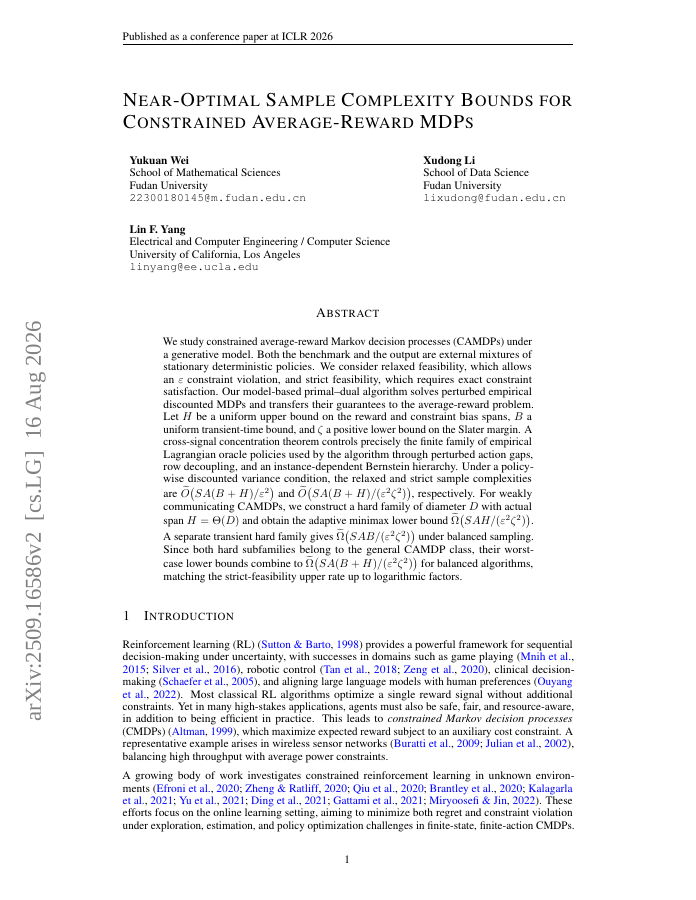
Recent advances have significantly improved our understanding of the sample complexity of learning in average-reward Markov decision processes (AMDPs) under the generative model. However, much less is known about the constrained average-reward MDP (CAMDP), where policies must satisfy long-run average constraints. In this work, we address this gap by studying the sample complexity of learning an ε-optimal policy in CAMDPs under a generative model. We propose a model-based algorithm that operates under two settings: (i) relaxed feasibility, which allows small constraint violations, and (ii) strict feasibility, where the output policy satisfies the constraint. We show that our algorithm achieves sample complexities of \tilde{O}\left(\frac{S A (B+H)}{ ε^2}\right) and \tilde{O} \left(\frac{S A (B+H)}{ε^2 ζ^2} \right) under the relaxed and strict feasibility settings, respectively. Here, ζ is the Slater constant indicating the size of the feasible region, H is the span bound of the bias function, and B is the transient time bound. Moreover, a matching lower bound of \tildeΩ\left(\frac{S A (B+H)}{ ε^2ζ^2}\right) for the strict feasibility case is established, thus providing the first minimax-optimal bounds for CAMDPs. Our results close the theoretical gap in understanding the complexity of constrained average-reward MDPs.
Near-Optimal Sample Complexity Bounds for Constrained Average-Reward MDPs
Recent advances have significantly improved our understanding of the sample complexity of learning in average-reward Markov decision processes (AMDPs) under the generative model.
- Preview
- Year
- 2025
- Hosting
- Full text hostedCC-BY-4.0
Cite
Notes
Only stored in your browser.
Attribution
- Abstract & full text
- arxiv.org/abs/2509.16586CC-BY-4.0
- TL;DR
- Semantic Scholar