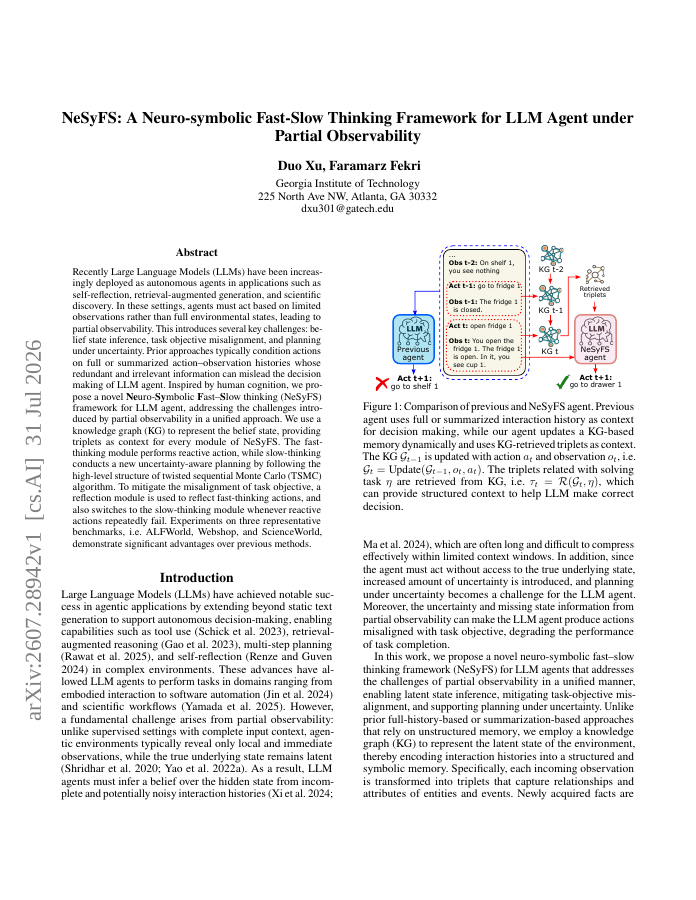
Recently Large Language Models (LLMs) have been increasingly deployed as autonomous agents in applications such as self-reflection, retrieval-augmented generation, and scientific discovery. In these settings, agents must act based on limited observations rather than full environmental states, leading to partial observability. This introduces several key challenges: belief state inference, task objective misalignment, and planning under uncertainty. Prior approaches typically condition actions on full or summarized action-observation histories whose redundant and irrelevant information can mislead the decision making of LLM agent. Inspired by human cognition, we propose a novel neuro-symbolic fast-slow thinking (NeSyFS) framework for LLM agent, addressing the challenges introduced by partial observability in a unified approach. We use a knowledge graph (KG) to represent the belief state, providing triplets as context for every module of NeSyFS. The fast-thinking module performs reactive action, while slow-thinking conducts a new uncertainty-aware planning by following the high-level structure of twisted sequential Monte Carlo (TSMC) algorithm. To mitigate the misalignment of task objective, a reflection module is used to reflect fast-thinking actions, and also switches to the slow-thinking module whenever reactive actions repeatedly fail. Experiments on three representative benchmarks, i.e. ALFWorld, Webshop, and ScienceWorld, demonstrate significant advantages over previous methods.
NeSyFS: A Neuro-symbolic Fast-Slow Thinking Framework for LLM Agent under Partial Observability
Recently Large Language Models (LLMs) have been increasingly deployed as autonomous agents in applications such as self-reflection, retrieval-augmented generation, and scientific discovery.
- Preview
- Year
- 2026
- Hosting
- Full text hostedCC-BY-4.0
Cite
Notes
Only stored in your browser.
Attribution
- Abstract & full text
- arxiv.org/abs/2607.28942CC-BY-4.0
- TL;DR
- Semantic Scholar