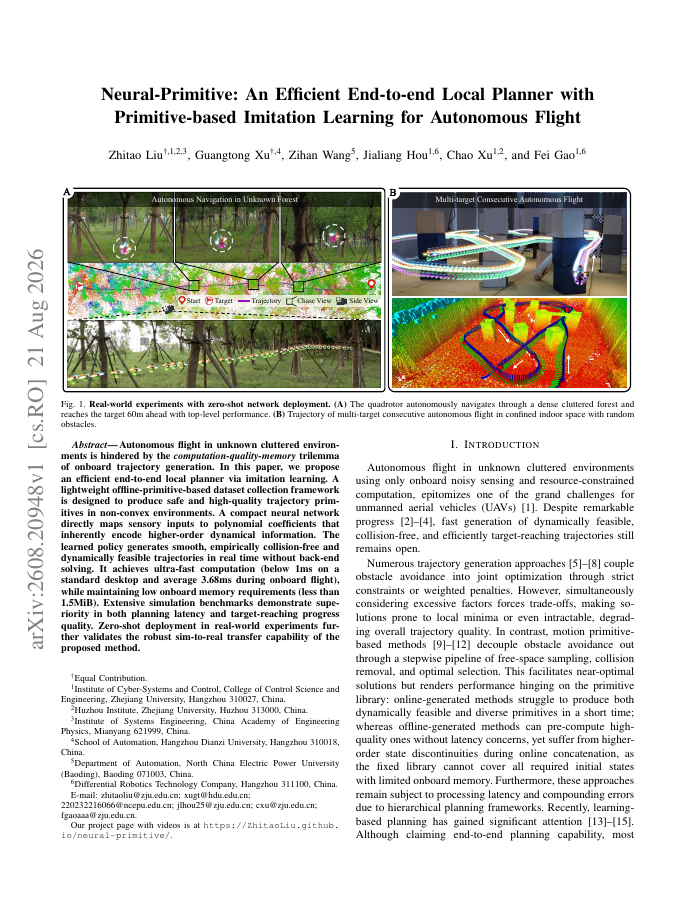
Autonomous flight in unknown cluttered environments is hindered by the computation-quality-memory trilemma of onboard trajectory generation. In this paper, we propose an efficient end-to-end local planner via imitation learning. A lightweight offline-primitive-based dataset collection framework is designed to produce safe and high-quality trajectory primitives in non-convex environments. A compact neural network directly maps sensory inputs to polynomial coefficients that inherently encode higher-order dynamical information. The learned policy generates smooth, empirically collision-free and dynamically feasible trajectories in real time without back-end solving. It achieves ultra-fast computation (below 1ms on a standard desktop and average 3.68ms during onboard flight), while maintaining low onboard memory requirements (less than 1.5MiB). Extensive simulation benchmarks demonstrate superiority in both planning latency and target-reaching progress quality. Zero-shot deployment in real-world experiments further validates the robust sim-to-real transfer capability of the proposed method.
Neural-Primitive: An Efficient End-to-end Local Planner with Primitive-based Imitation Learning for Autonomous Flight
Autonomous flight in unknown cluttered environments is hindered by the computation-quality-memory trilemma of onboard trajectory generation. In this paper, we propose an efficient end-to-end local planner via imitation learning.
- Preview
- Year
- 2026
- Hosting
- Abstract onlyARXIV-DEFAULT
Cite
Notes
Only stored in your browser.
Attribution
- Abstract & full text
- arxiv.org/abs/2608.20948ARXIV-DEFAULT
- TL;DR
- Semantic Scholar