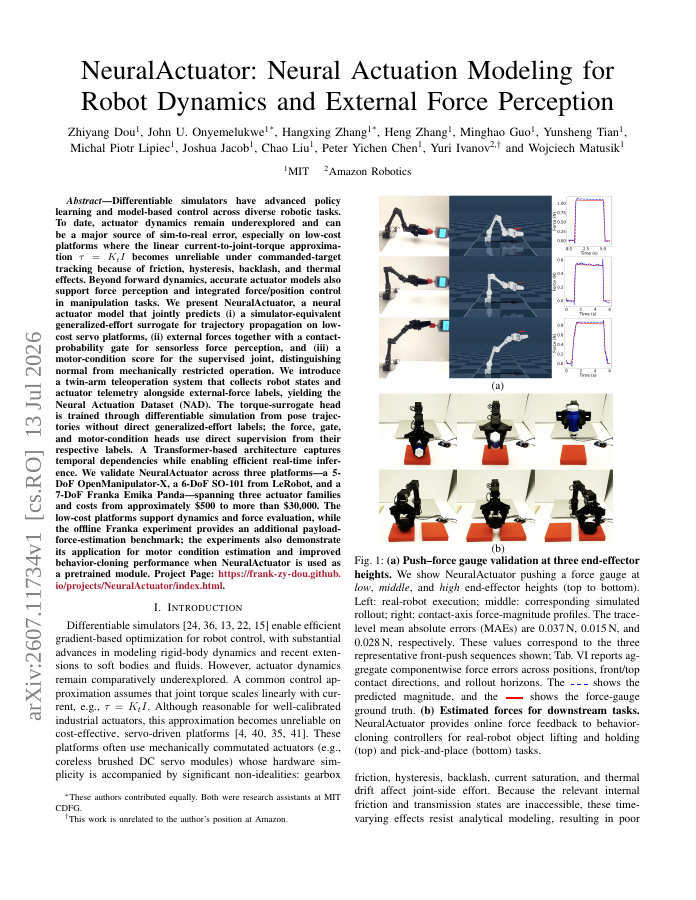
Differentiable simulators have advanced policy learning and model-based control across robotic tasks. Yet actuator dynamics remain underexplored and can be a major source of sim-to-real error, particularly on low-cost platforms, where the linear current-to-joint-torque approximation τ= K_t I becomes unreliable because of friction, hysteresis, backlash, and thermal effects. Accurate actuator models can also support force perception and integrated force/position control. We present NeuralActuator, which jointly predicts (i) a torque surrogate for trajectory propagation on low-cost servo platforms, (ii) external forces with a contact-probability gate for sensorless force perception, and (iii) a motor-condition score for a supervised joint, distinguishing normal from mechanically restricted operation. A twin-arm teleoperation system records robot states and actuator telemetry alongside external-force labels, yielding the Neural Actuation Dataset (NAD). The torque-surrogate head is trained through differentiable simulation from pose trajectories without ground-truth joint-torque measurements. A Transformer captures temporal dependencies while enabling real-time inference. We validate NeuralActuator on a 5-DoF OpenManipulator-X, a 6-DoF SO-101 from LeRobot, and a 7-DoF Franka Emika Panda, spanning three actuator families and costs from approximately \500 to more than \30{,}000. The low-cost platforms support physically plausible dynamics and force evaluation, while the offline Franka experiment provides a payload-force-estimation benchmark. We also demonstrate motor-condition estimation and improved behavior-cloning performance using NeuralActuator as a pretrained module. We release the dataset, code, and hardware configurations on the project page: https://frank-zy-dou.github.io/projects/NeuralActuator/index.html.
NeuralActuator: Neural Actuation Modeling for Robot Dynamics and External Force Perception
Differentiable simulators have advanced policy learning and model-based control across robotic tasks. Yet actuator dynamics remain underexplored and can be a major source of sim-to-real error, particularly on low-cost platforms, where the linear current-to-joint-torque…
- Preview
- Year
- 2026
- Hosting
- Full text hostedCC-BY-4.0
Cite
Notes
Only stored in your browser.
Attribution
- Abstract & full text
- arxiv.org/abs/2607.11734CC-BY-4.0
- TL;DR
- Semantic Scholar