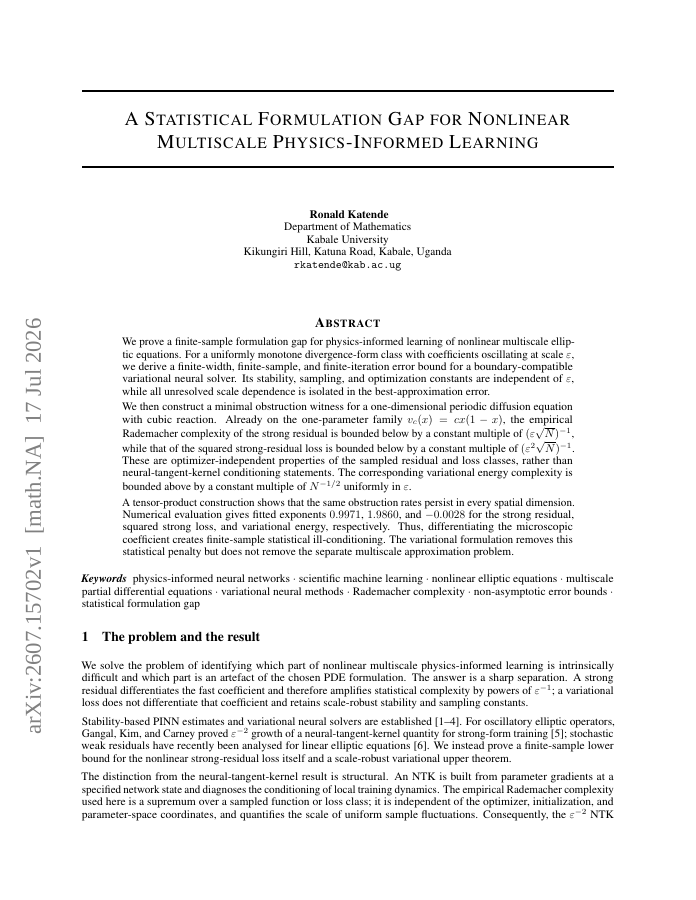
We develop a non-asymptotic approximation, sampling, and finite-iteration optimization theory for variational physics-informed approximation of uniformly monotone nonlinear multiscale elliptic equations. For boundary-compatible neural feature classes, the population error splits into approximation, empirical quadrature, and projected-gradient terms, with all non-approximation constants uniform in the microscopic scale \varepsilon. Assuming a quantitative corrected H^1-estimate, a two-scale state class yields [ \mathcal A_m^\varepsilon \le C\bigl(\varepsilon+Φ_{0,m_0}^2+Φ_{1,m_1}^2\bigr) ] in arbitrary dimension. We further introduce a convex primal-dual physics loss whose population value is a computable upper certificate for the state error. With additional flux-corrector regularity, a divergence-compatible two-scale flux class gives a certified state-flux bound combining O(\varepsilon) approximation, state and flux feature errors, empirical sampling error, and an O(K^{-1}) optimization term. In contrast, for general periodic nonlinear fluxes satisfying a natural nondegeneracy condition, the empirical Rademacher complexities of strong-residual and squared-residual classes are bounded below by constant multiples of (\varepsilon\sqrt N)^{-1} and (\varepsilon^2\sqrt N)^{-1}, respectively. These optimizer-independent lower bounds hold in every spatial dimension. Numerical experiments confirm the predicted \varepsilon- and N-scalings for nonlinear fluxes in d=1,2,3, validate every computed primal-dual certificate, and show that corrector-enriched classes substantially reduce energy and H^1 errors as the microscopic scale is refined.
Non-Asymptotic Variational Learning for Monotone Nonlinear Multiscale Elliptic Equations: Scale-Robust Primal-Dual Bounds and Strong-Form Statistical Ill-Conditioning
We develop a non-asymptotic approximation, sampling, and finite-iteration optimization theory for variational physics-informed approximation of uniformly monotone nonlinear multiscale elliptic equations.
- Preview
- Year
- 2026
- Hosting
- Full text hostedCC-BY-4.0
Cite
Notes
Only stored in your browser.
Attribution
- Abstract & full text
- arxiv.org/abs/2607.15702CC-BY-4.0
- TL;DR
- Semantic Scholar