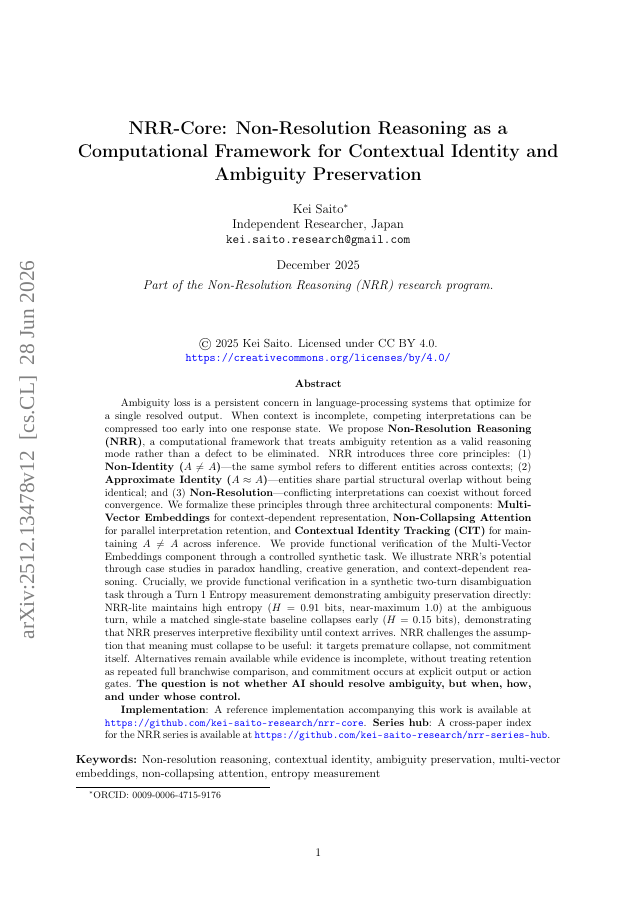
Language-processing systems that optimize for a single resolved output risk losing ambiguity. With incomplete context, competing interpretations may be compressed prematurely. We specify Non-Resolution Reasoning (NRR) as an explicit retention-commitment interface for preserving context-indexed alternatives until evidence supports commitment. NRR organizes context-indexed alternatives, independently active weights, declared retention and commitment operations, and non-destructive output projection around three principles: Context-indexed Non-Identity, Approximate Identity, and Non-Resolution. It specifies a retained state and candidate operator vocabulary, and proposes Multi-Vector Embeddings, Non-Collapsing Attention, and Contextual Identity Tracking as implementable architectural realizations. In a reproducible synthetic two-turn task, one gated Multi-Vector-Embedding instantiation maintains high output entropy before disambiguating context arrives (H = 0.91 bits, near the 1.0-bit maximum), while a controlled single-embedding baseline has low entropy (H = 0.15 bits); both tested systems resolve correctly after context arrives. Thus, high pre-context output uncertainty and accurate later resolution can coexist in the tested gated configuration. This result does not validate the full NRR architecture or matched-parameter superiority; the specification, proposed components, and demonstrated behavior remain distinct contribution layers. NRR targets premature commitment, not commitment itself: alternatives can remain available while evidence is incomplete, and commitment occurs at explicit output or action gates. The question is not whether AI should resolve ambiguity, but when, how, and under whose control. Implementation: https://github.com/kei-saito-research/nrr-core. Series hub: https://github.com/kei-saito-research/nrr-series-hub.
NRR-Core: Non-Resolution Reasoning as a Computational Framework for Contextual Identity and Ambiguity Preservation
Language-processing systems that optimize for a single resolved output risk losing ambiguity. With incomplete context, competing interpretations may be compressed prematurely.
- Preview
- Year
- 2025
- Hosting
- Full text hostedCC-BY-4.0
Cite
Notes
Only stored in your browser.
Attribution
- Abstract & full text
- arxiv.org/abs/2512.13478CC-BY-4.0
- TL;DR
- Semantic Scholar