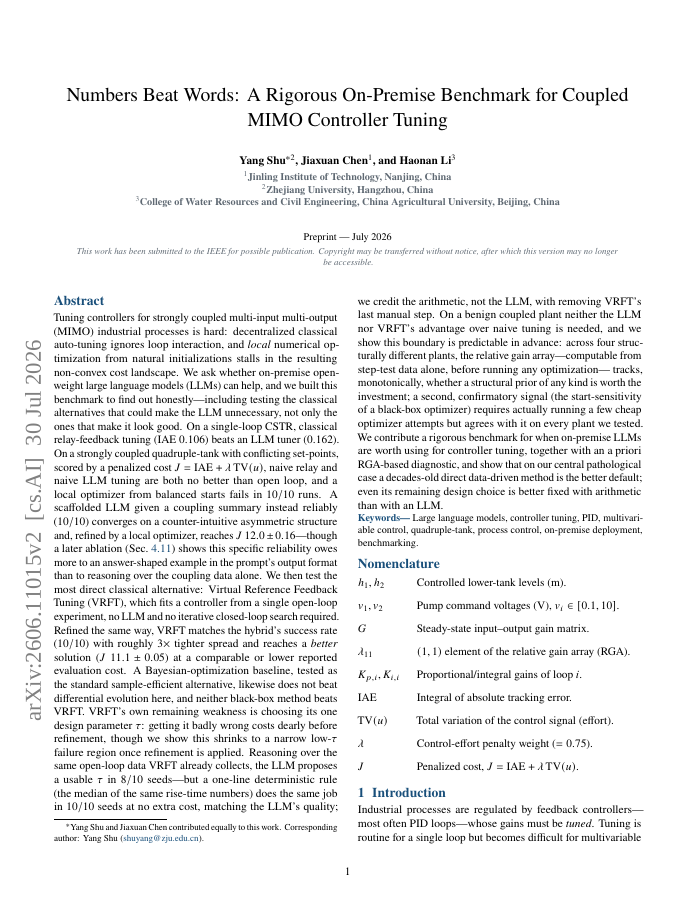
Tuning controllers for strongly coupled multi-input multi-output (MIMO) processes is difficult because decentralized auto-tuning ignores loop interaction and local optimization is start-sensitive. We benchmark whether on-premise open-weight large language models (LLMs) provide useful structural priors, while testing classical alternatives that may make them unnecessary. On a single-loop CSTR, relay-feedback tuning outperforms the LLM. On a pathological quadruple-tank, naive relay, naive LLM, and balanced-start local optimization fail, whereas a scaffolded LLM finds a reliable asymmetric basin and, after local refinement, reaches J = 12.0 +/- 0.16 in 10/10 runs. However, an ablation shows that this reliability depends more on an answer-shaped prompt example than on reasoning over coupling data. A direct data-driven alternative, Virtual Reference Feedback Tuning (VRFT), uses one open-loop experiment and no LLM; with the same refinement it succeeds in 10/10 runs and improves the result to J = 11.12 +/- 0.05. Although VRFT requires a reference-model time constant tau, a deterministic median-tau rule matches or exceeds LLM-guided selection at no extra cost. Across four structurally different plants, the relative gain array computed from step tests predicts when a structural prior is worth using; optimizer start-sensitivity provides a confirming second signal. The resulting boundary is clear: use classical tuning on benign plants, prefer VRFT when informative open-loop data are available, and reserve LLMs for structural initialization when direct routes are unavailable. The benchmark shows that the LLM's value is structural rather than numerical, and that on the central case, numbers beat words.
Numbers Beat Words: A Rigorous On-Premise Benchmark for Coupled MIMO Controller Tuning
Tuning controllers for strongly coupled multi-input multi-output (MIMO) processes is difficult because decentralized auto-tuning ignores loop interaction and local optimization is start-sensitive.
- Preview
- Year
- 2026
- Hosting
- Abstract onlyARXIV-DEFAULT
Cite
Notes
Only stored in your browser.
Attribution
- Abstract & full text
- arxiv.org/abs/2606.11015ARXIV-DEFAULT
- TL;DR
- Semantic Scholar