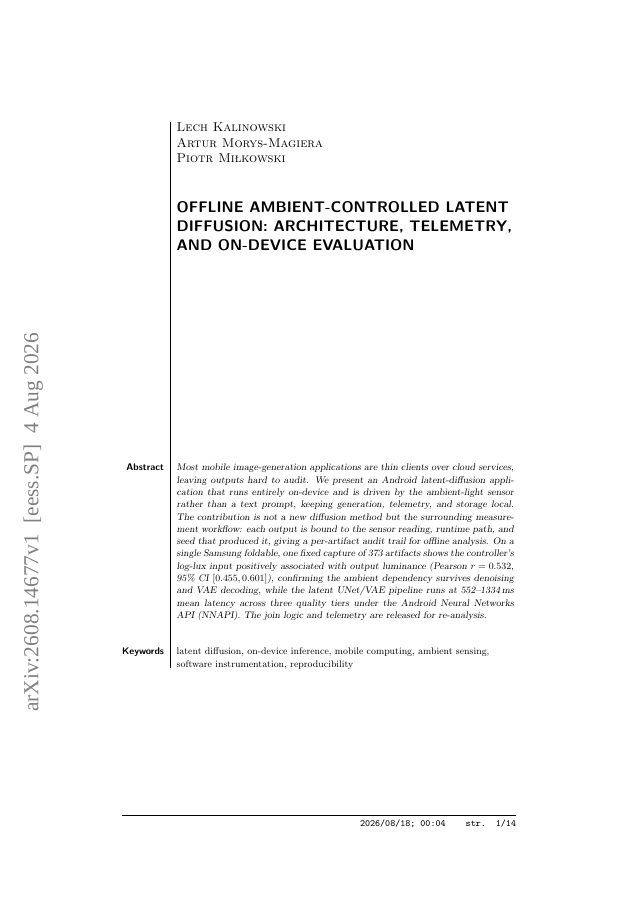
Most mobile image-generation applications are thin clients over cloud services, leaving outputs hard to audit. We present an Android latent-diffusion application that runs entirely on-device and is driven by the ambient-light sensor rather than a text prompt, keeping generation, telemetry, and storage local. The contribution is not a new diffusion method but the surrounding measurement workflow: each output is bound to the sensor reading, runtime path, and seed that produced it, giving a per-artifact audit trail for offline analysis. On a single Samsung foldable, one fixed capture of 373 artifacts shows the controller's log-lux input positively associated with output luminance (Pearson r=0.532, 95% CI [0.455, 0.601]), confirming the ambient dependency survives denoising and VAE decoding, while the latent UNet/VAE pipeline runs at 552--1334,ms mean latency across three quality tiers under the Android Neural Networks API (NNAPI).
Offline Ambient-Controlled Latent Diffusion: Architecture, Telemetry, and On-Device Evaluation
Most mobile image-generation applications are thin clients over cloud services, leaving outputs hard to audit. We present an Android latent-diffusion application that runs entirely on-device and is driven by the ambient-light sensor rather than a text prompt, keeping generation,…
- Preview
- Year
- 2026
- Hosting
- Abstract onlyARXIV-DEFAULT
Cite
Notes
Only stored in your browser.
Attribution
- Abstract & full text
- arxiv.org/abs/2608.14677ARXIV-DEFAULT
- TL;DR
- Semantic Scholar