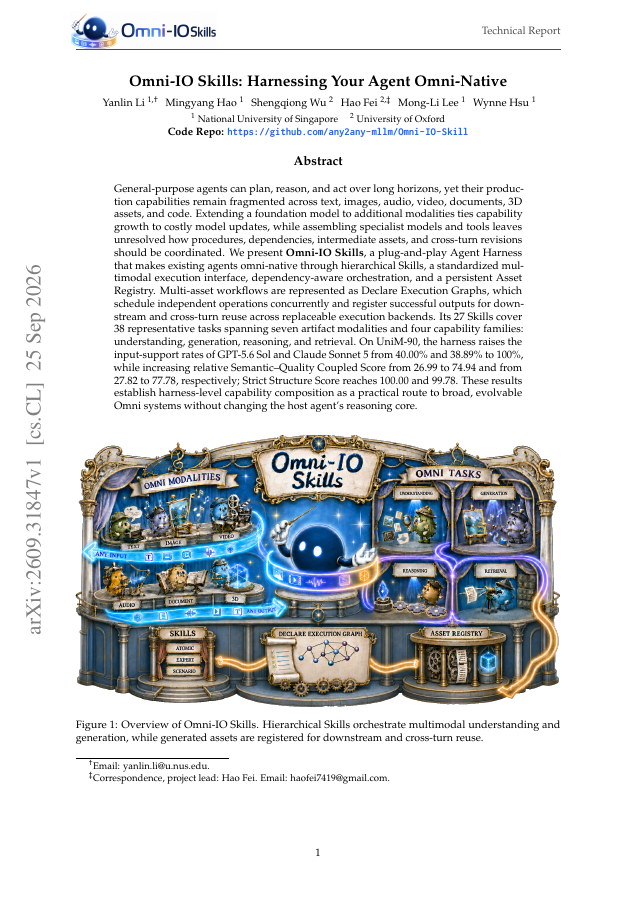
General-purpose agents can plan, reason, and act over long horizons, yet their production capabilities remain fragmented across text, images, audio, video, documents, 3D assets, and code. Extending a foundation model to additional modalities ties capability growth to costly model updates, while assembling specialist models and tools leaves unresolved how procedures, dependencies, intermediate assets, and cross-turn revisions should be coordinated. We present Omni-IO Skills, a plug-and-play Agent Harness that makes existing agents omni-native through hierarchical Skills, a standardized multimodal execution interface, dependency-aware orchestration, and a persistent Asset Registry. Multi-asset workflows are represented as Declare Execution Graphs, which schedule independent operations concurrently and register successful outputs for downstream and cross-turn reuse across replaceable execution backends. Its 27 Skills cover 38 representative tasks spanning seven artifact modalities and four capability families: understanding, generation, reasoning, and retrieval. On UniM-90, the harness raises the input-support rates of GPT-5.6 Sol and Claude Sonnet 5 from 40.00% and 38.89% to 100%, while increasing relative Semantic--Quality Coupled Score from 26.99 to 74.94 and from 27.82 to 77.78, respectively; Strict Structure Score reaches 100.00 and 99.78. These results establish harness-level capability composition as a practical route to broad, evolvable Omni systems without changing the host agent's reasoning core.
Omni-IO Skills: Harnessing Your Agent Omni-Native
General-purpose agents can plan, reason, and act over long horizons, yet their production capabilities remain fragmented across text, images, audio, video, documents, 3D assets, and code.
- Preview
- Year
- 2026
- Stars
- 33
- Hosting
- Abstract onlyARXIV-DEFAULT
Cite
Notes
Only stored in your browser.
Attribution
- Abstract & full text
- arxiv.org/abs/2609.31847ARXIV-DEFAULT
- TL;DR
- Semantic Scholar