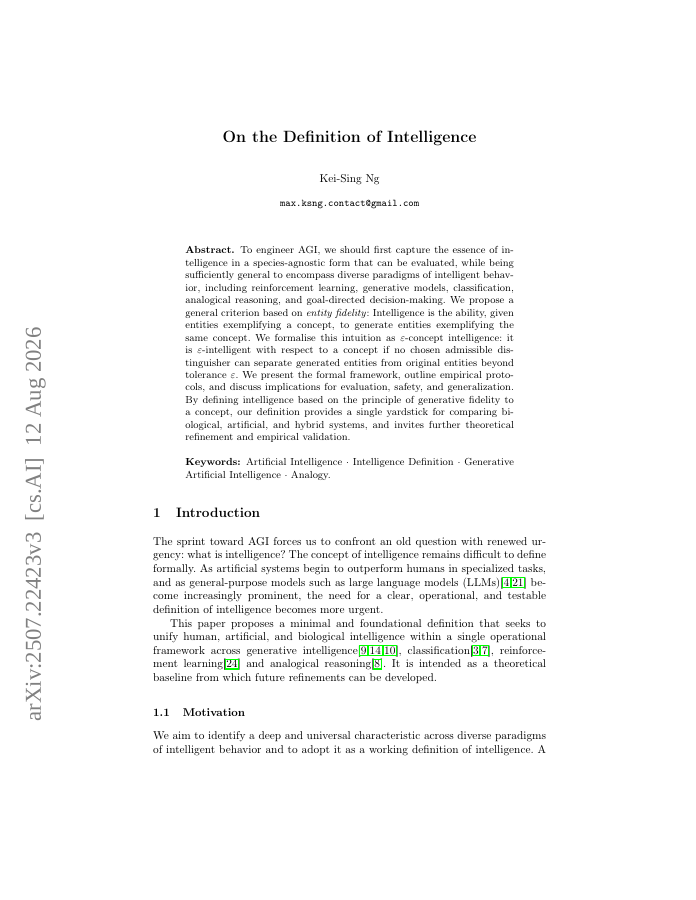
To engineer AGI, we should first capture the essence of intelligence in a species-agnostic form that can be evaluated, while being sufficiently general to encompass diverse paradigms of intelligent behavior, including reinforcement learning, generative models, classification, analogical reasoning, and goal-directed decision-making. We propose a general criterion based on entity fidelity: Intelligence is the ability, given entities exemplifying a concept, to generate entities exemplifying the same concept. We formalise this intuition as \varepsilon-concept intelligence: it is \varepsilon-intelligent with respect to a concept if no chosen admissible distinguisher can separate generated entities from original entities beyond tolerance \varepsilon. We present the formal framework, outline empirical protocols, and discuss implications for evaluation, safety, and generalization.
On the Definition of Intelligence
To engineer AGI, we should first capture the essence of intelligence in a species-agnostic form that can be evaluated, while being sufficiently general to encompass diverse paradigms of intelligent behavior, including reinforcement learning, generative models, classification,…
- Preview
- Year
- 2025
- Hosting
- Full text hostedCC-BY-4.0
Cite
Notes
Only stored in your browser.
Attribution
- Abstract & full text
- arxiv.org/abs/2507.22423CC-BY-4.0
- TL;DR
- Semantic Scholar