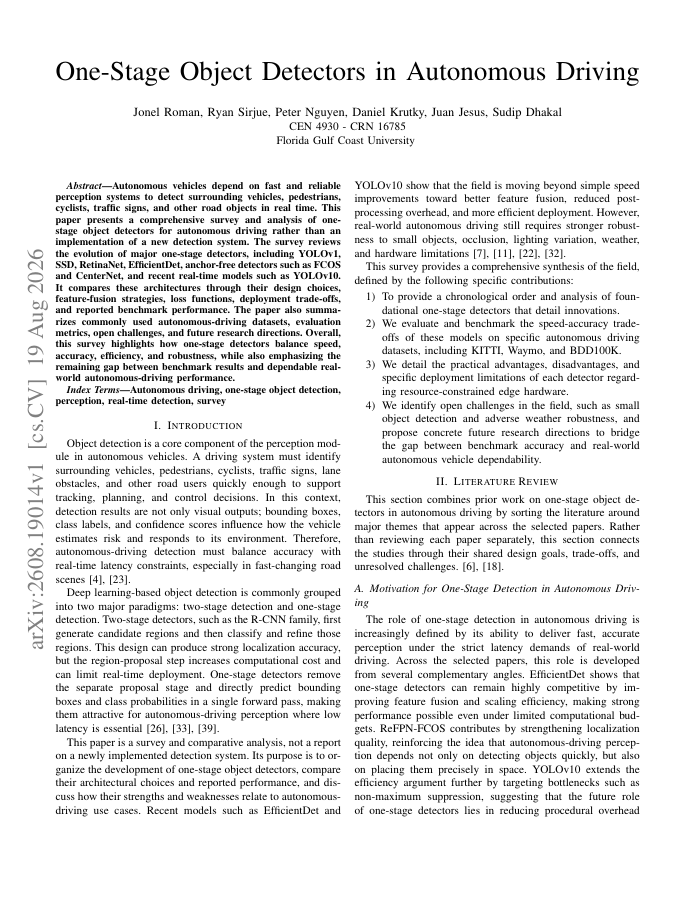
Autonomous vehicles depend on fast and reliable perception systems to detect surrounding vehicles, pedestrians, cyclists, traffic signs, and other road objects in real time. This paper presents a comprehensive survey and analysis of one-stage object detectors for autonomous driving rather than an implementation of a new detection system. The survey reviews the evolution of major one-stage detectors, including YOLOv1, SSD, RetinaNet, EfficientDet, anchor-free detectors such as FCOS and CenterNet, and recent real-time models such as YOLOv10. It compares these architectures through their design choices, feature-fusion strategies, loss functions, deployment trade-offs, and reported benchmark performance. The paper also summarizes commonly used autonomous-driving datasets, evaluation metrics, open challenges, and future research directions. Overall, this survey highlights how one-stage detectors balance speed, accuracy, efficiency, and robustness, while also emphasizing the remaining gap between benchmark results and dependable real-world autonomous-driving performance.
One-Stage Object Detectors in Autonomous Driving
Autonomous vehicles depend on fast and reliable perception systems to detect surrounding vehicles, pedestrians, cyclists, traffic signs, and other road objects in real time.
- Preview
- Year
- 2026
- Hosting
- Full text hostedCC0
Cite
Notes
Only stored in your browser.