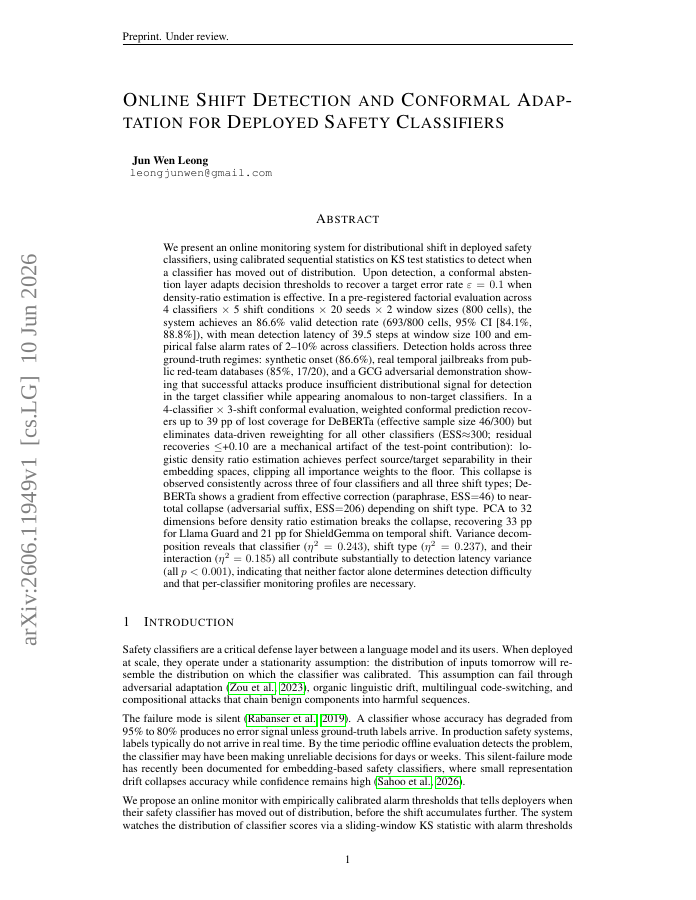
Safety classifiers deployed in production operate under a stationarity assumption that fails silently: when input distributions drift, accuracy degrades with no error signal until ground-truth labels arrive. We present an online monitor that detects distributional shift in classifier scores via a sliding-window KS statistic with empirically calibrated alarm thresholds. In a pre-registered factorial evaluation (4 classifiers \times 5 shift conditions \times 20 seeds \times 2 window sizes; 800 cells), the monitor achieves 86.6% valid detection (mean latency 39.5 steps) across synthetic-onset, real-jailbreak, and adversarial regimes; a classifier \times shift interaction (η^2 = 0.185) shows that monitoring must be tuned per classifier. Attempting to recover post-detection coverage via weighted conformal prediction exposes a failure mode: density-ratio estimation collapses for generative classifiers because logistic regression separates source from target perfectly in 3584-4096-dimensional embedding space, clipping all importance weights to zero; projecting to \leq 32 dimensions restores coverage. We then extend the framework to gradient-based evasion and give the first threat-model characterisation of score-disagreement monitoring as a canary. We falsify three assumptions: that architectural diversity drives the signal (false, η^2 = 0.011), that it is generic out-of-distribution detection (false, GCG-specific, p < 10^{-12}), and that an adaptive attacker can suppress it (false while the canary is confident). We derive the exact security boundary, a confidence-gated equilibrium at which a monitor-aware attacker stalls at gap = 1/(2λ), and provide a calibration-free scan martingale achieving false-alarm rate \leq 1% across all classifiers with no per-model tuning.
Online Shift Detection and Conformal Adaptation for Deployed Safety Classifiers
Safety classifiers deployed in production operate under a stationarity assumption that fails silently: when input distributions drift, accuracy degrades with no error signal until ground-truth labels arrive.
- Preview
- Year
- 2026
- Hosting
- Full text hostedCC-BY-4.0
Cite
Notes
Only stored in your browser.
Attribution
- Abstract & full text
- arxiv.org/abs/2606.11949CC-BY-4.0
- TL;DR
- Semantic Scholar