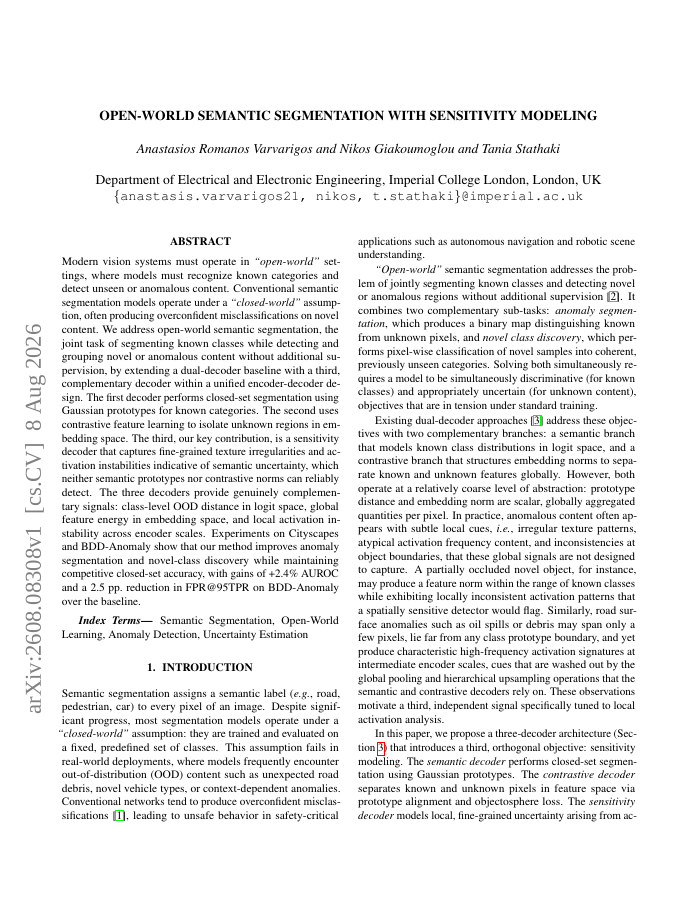
Modern vision systems must operate in "open-world" settings, where models must recognize known categories and detect unseen or anomalous content. Conventional semantic segmentation models operate under a "closed-world" assumption, often producing overconfident misclassifications on novel content. We address open-world semantic segmentation, the joint task of segmenting known classes while detecting and grouping novel or anomalous content without additional supervision, by extending a dual-decoder baseline with a third, complementary decoder within a unified encoder-decoder design. The first decoder performs closed-set segmentation using Gaussian prototypes for known categories. The second uses contrastive feature learning to isolate unknown regions in embedding space. The third, our key contribution, is a sensitivity decoder that captures fine-grained texture irregularities and activation instabilities indicative of semantic uncertainty, which neither semantic prototypes nor contrastive norms can reliably detect. The three decoders provide genuinely complementary signals: class-level OOD distance in logit space, global feature energy in embedding space, and local activation instability across encoder scales. Experiments on Cityscapes and BDD-Anomaly show that our method improves anomaly segmentation and novel-class discovery while maintaining competitive closed-set accuracy, with gains of +2.4% AUROC and a 2.5 pp. reduction in FPR@95TPR on BDD-Anomaly over the baseline.
Open-World Semantic Segmentation with Sensitivity Modeling
Modern vision systems must operate in "open-world" settings, where models must recognize known categories and detect unseen or anomalous content. Conventional semantic segmentation models operate under a "closed-world" assumption, often producing overconfident…
- Preview
- Year
- 2026
- Hosting
- Full text hostedCC-BY-4.0
Cite
Notes
Only stored in your browser.
Attribution
- Abstract & full text
- arxiv.org/abs/2608.08308CC-BY-4.0
- TL;DR
- Semantic Scholar