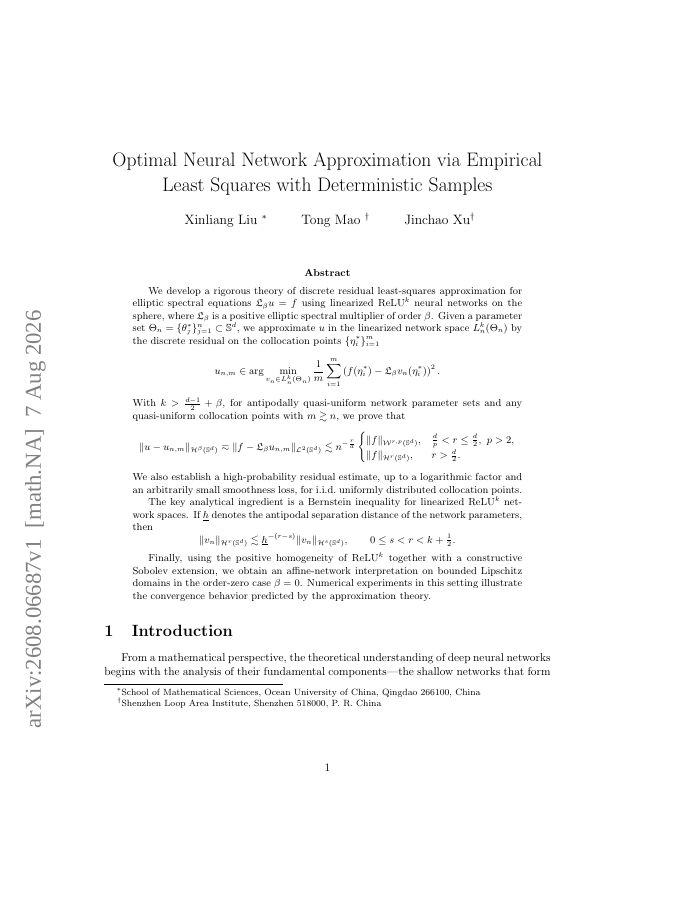
We develop a rigorous theory of discrete residual least-squares approximation for elliptic spectral equations \mathfrak L_βu=f using linearized ReLU^k neural networks on the sphere, where \mathfrak L_β is a positive elliptic spectral multiplier of order β. Given a parameter set Θ_n={θ_{j}^}_{j=1}^n\subset\mathbb S^d, we approximate u in the linearized network space L_n^k(Θ_n) by the discrete residual on the collocation points {η_i^}{i=1}^m \begin{equation*} u{n,m}\in\arg\min_{v_n\in L_n^k(Θ_n)}\frac1m\sum_{i=1}^m\left(f(η_i^)-\mathfrak L_βv_n(η_i^)\right)^2. \end{equation*} With k>\frac{d-1}{2}+β, for antipodally quasi-uniform network parameter sets and any quasi-uniform collocation points with m\gtrsim n, we prove that \begin{equation*} |u-u_{n,m}|{\mathcal H^β(\mathbb S^d)}\eqsim|f-\mathfrak L_βu{n,m}|{\mathcal L^2(\mathbb S^d)}\lesssim n^{-\frac{r}{d}} \begin{cases} |f|{\mathcal W^{r,p}(\mathbb S^d)},&\frac{d}{p}<r\leq \frac{d}{2}, p>2,\ |f|{\mathcal H^r(\mathbb S^d)},&r>\frac{d}{2}. \end{cases} \end{equation*} We also establish a high-probability residual estimate, up to a logarithmic factor and an arbitrarily small smoothness loss, for i.i.d.\ uniformly distributed collocation points. The key analytical ingredient is a Bernstein inequality for linearized ReLU^k network spaces. If \underline h denotes the antipodal separation distance of the network parameters, then \begin{equation*} |v_n|{\mathcal H^r(\mathbb S^d)}\lesssim\underline h^{-(r-s)}|v_n|_{\mathcal H^s(\mathbb S^d)},\qquad 0\leq s<r<k+\tfrac12. \end{equation*}
Optimal Neural Network Approximation via Empirical Least Squares with Deterministic Samples
We develop a rigorous theory of discrete residual least-squares approximation for elliptic spectral equations $\mathfrak L_βu=f$ using linearized ReLU$^k$ neural networks on the sphere, where $\mathfrak L_β$ is a positive elliptic spectral multiplier of order $β$.
- Preview
- Year
- 2026
- Hosting
- Full text hostedCC-BY-4.0
Cite
Notes
Only stored in your browser.
Attribution
- Abstract & full text
- arxiv.org/abs/2608.06687CC-BY-4.0
- TL;DR
- Semantic Scholar