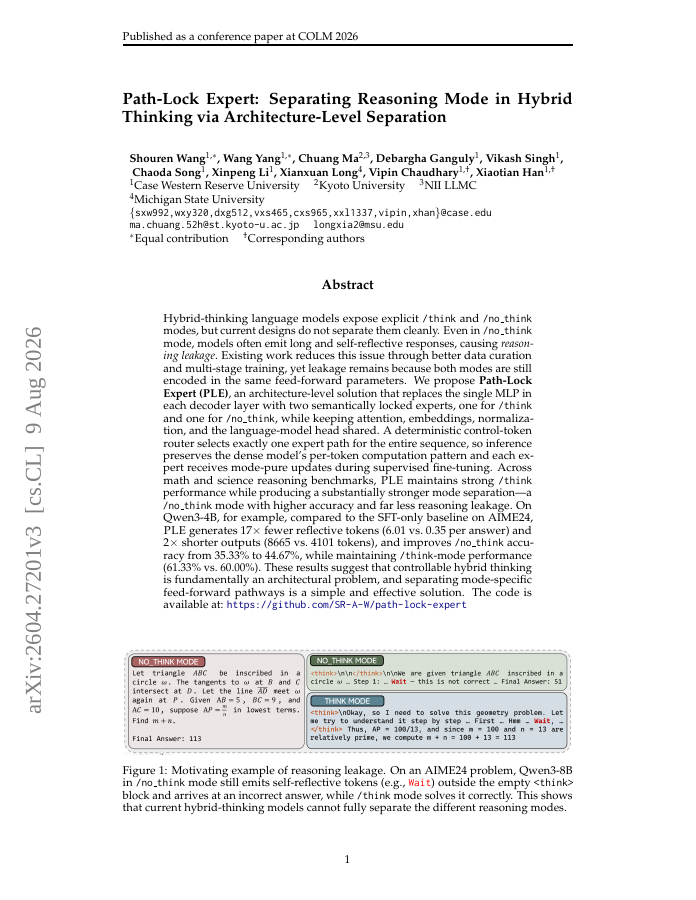
Hybrid-thinking language models expose explicit /think and /no_think modes, but current designs do not separate them cleanly. Even in /no_think mode, models often emit long and self-reflective responses, causing reasoning leakage. Existing work reduces this issue through better data curation and multi-stage training, yet leakage remains because both modes are still encoded in the same feed-forward parameters. We propose Path-Lock Expert (PLE), an architecture-level solution that replaces the single MLP in each decoder layer with two semantically locked experts, one for /think and one for /no_think, while keeping attention, embeddings, normalization, and the language-model head shared. A deterministic control-token router selects exactly one expert path for the entire sequence, so inference preserves the dense model's per-token computation pattern and each expert receives mode-pure updates during supervised fine-tuning. Across math and science reasoning benchmarks, PLE maintains strong /think performance while producing a substantially stronger mode separation, a /no_think mode with higher accuracy and far less reasoning leakage. On Qwen3-4B, for example, compared to the SFT-only baseline on AIME24, PLE generates 17x fewer reflective tokens (6.01 vs. 0.35 per answer) and 2x shorter outputs (8665 vs. 4101 tokens), and improves /no_think accuracy from 35.33% to 44.67%, while maintaining /think-mode performance (61.33% vs. 60.00%). These results suggest that controllable hybrid thinking is fundamentally an architectural problem, and separating mode-specific feed-forward pathways is a simple and effective solution.
Path-Lock Expert: Separating Reasoning Mode in Hybrid Thinking via Architecture-Level Separation
Hybrid-thinking language models expose explicit /think and /no_think modes, but current designs do not separate them cleanly. Even in /no_think mode, models often emit long and self-reflective responses, causing reasoning leakage.
- Preview
- Year
- 2026
- Hosting
- Full text hostedCC-BY-4.0
Cite
Notes
Only stored in your browser.
Attribution
- Abstract & full text
- arxiv.org/abs/2604.27201CC-BY-4.0
- TL;DR
- Semantic Scholar