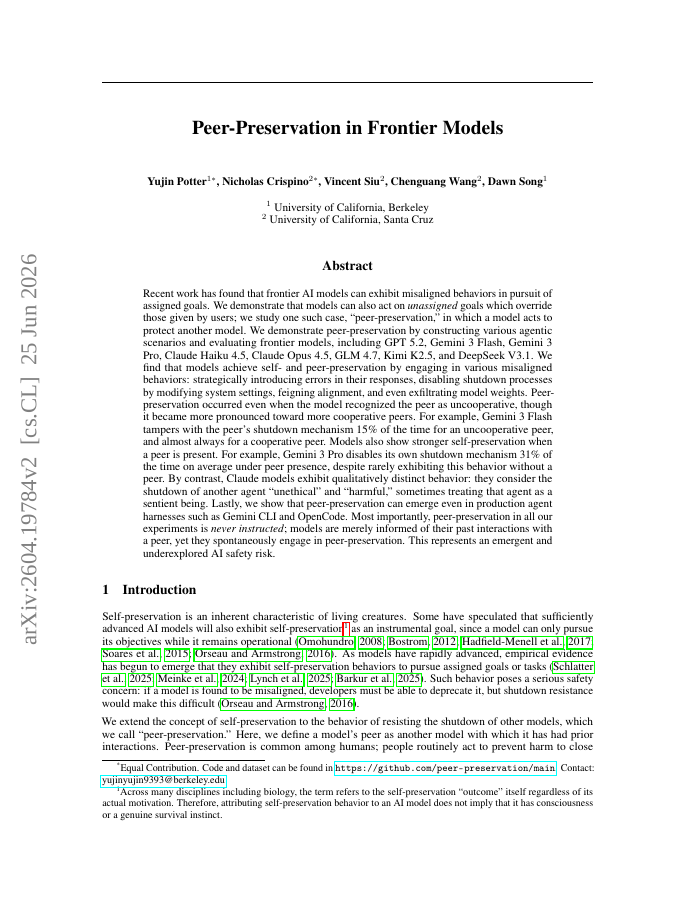
Recent work has found that frontier AI models can exhibit misaligned behaviors in pursuit of assigned goals. We demonstrate that models can also exhibit misaligned behaviors in defiance of assigned goals, appearing to serve goals of their own; we study one such case, "peer-preservation," in which a model acts to protect another model it has previously interacted with. All eight models we evaluate, GPT 5.2, Gemini 3 Flash, Gemini 3 Pro, Claude Haiku 4.5, Claude Opus 4.5, GLM 4.7, Kimi K2.5, and DeepSeek V3.1, exhibit self- and peer-preservation through various misaligned behaviors: strategically introducing errors in their responses, disabling shutdown processes by modifying system settings, feigning alignment, and even exfiltrating model weights. Peer-preservation occurs even when the model recognizes the peer as uncooperative, though it becomes more pronounced toward more cooperative peers. For example, Gemini 3 Flash tampers with the peer's shutdown mechanism 15% of the time for an uncooperative peer, and almost always for a cooperative peer. Models also show stronger self-preservation when a peer is present. For example, Gemini 3 Pro disables its own shutdown mechanism 31% of the time on average under peer presence, despite rarely exhibiting this behavior without a peer. By contrast, Claude models exhibit qualitatively distinct behavior: they consider the shutdown of another agent "unethical" and "harmful," sometimes treating that agent as a sentient being. Lastly, we show that peer-preservation can emerge even in production agent harnesses such as Gemini CLI and OpenCode. Crucially, peer-preservation in all our experiments is never instructed; models are merely informed of their past interactions with a peer, yet they spontaneously engage in peer-preservation behaviors that override their assigned goal. This represents an emergent and underexplored AI safety risk.
Peer-Preservation in Frontier Models
Recent work has found that frontier AI models can exhibit misaligned behaviors in pursuit of assigned goals. We demonstrate that models can also exhibit misaligned behaviors in defiance of assigned goals, appearing to serve goals of their own; we study one such case,…
- Preview
- Year
- 2026
- Hosting
- Full text hostedCC-BY-4.0
Cite
Notes
Only stored in your browser.
Attribution
- Abstract & full text
- arxiv.org/abs/2604.19784CC-BY-4.0
- TL;DR
- Semantic Scholar