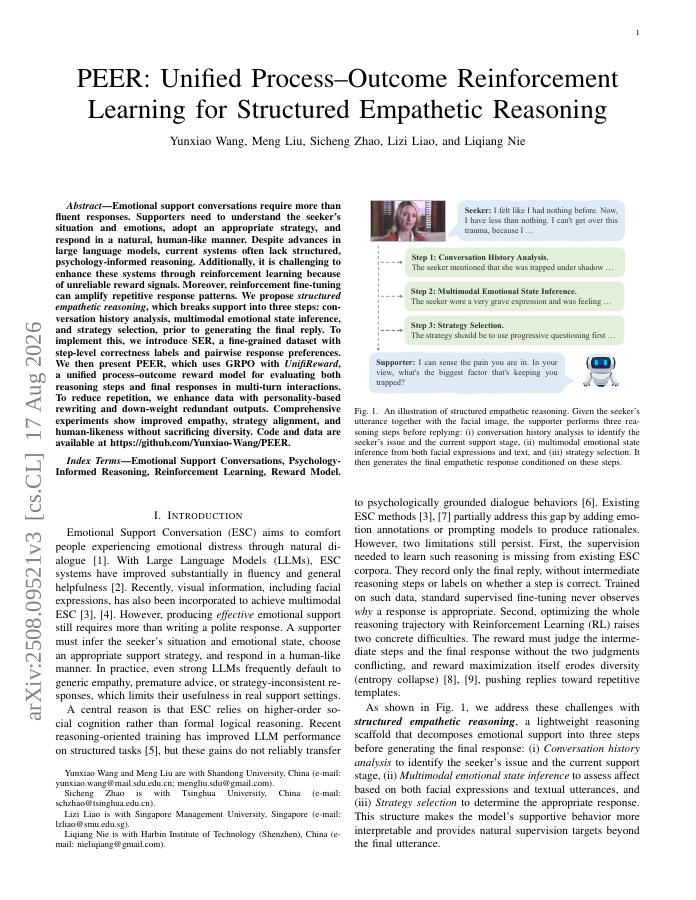
Emotional support conversations require more than fluent responses. Supporters need to understand the seeker's situation and emotions, adopt an appropriate strategy, and respond in a natural, human-like manner. Despite advances in large language models, current systems often lack structured, psychology-informed reasoning. Additionally, it is challenging to enhance these systems through reinforcement learning because of unreliable reward signals. Moreover, reinforcement fine-tuning can amplify repetitive response patterns. We propose structured empathetic reasoning, which breaks support into three steps: conversation history analysis, multimodal emotional state inference, and strategy selection, prior to generating the final reply. To implement this, we introduce SER, a fine-grained dataset with step-level correctness labels and pairwise response preferences. We then present PEER, which uses GRPO with UnifiReward, a unified process-outcome reward model for evaluating both reasoning steps and final responses in multi-turn interactions. To reduce repetition, we enhance data with personality-based rewriting and down-weight redundant outputs. Comprehensive experiments show improved empathy, strategy alignment, and human-likeness without sacrificing diversity. Code and data are available at https://github.com/Yunxiao-Wang/PEER.
PEER: Unified Process-Outcome Reinforcement Learning for Structured Empathetic Reasoning
Emotional support conversations require more than fluent responses. Supporters need to understand the seeker's situation and emotions, adopt an appropriate strategy, and respond in a natural, human-like manner.
- Preview
- Year
- 2025
- Hosting
- Abstract onlyARXIV-DEFAULT
Cite
Notes
Only stored in your browser.
Attribution
- Abstract & full text
- arxiv.org/abs/2508.09521ARXIV-DEFAULT
- TL;DR
- Semantic Scholar