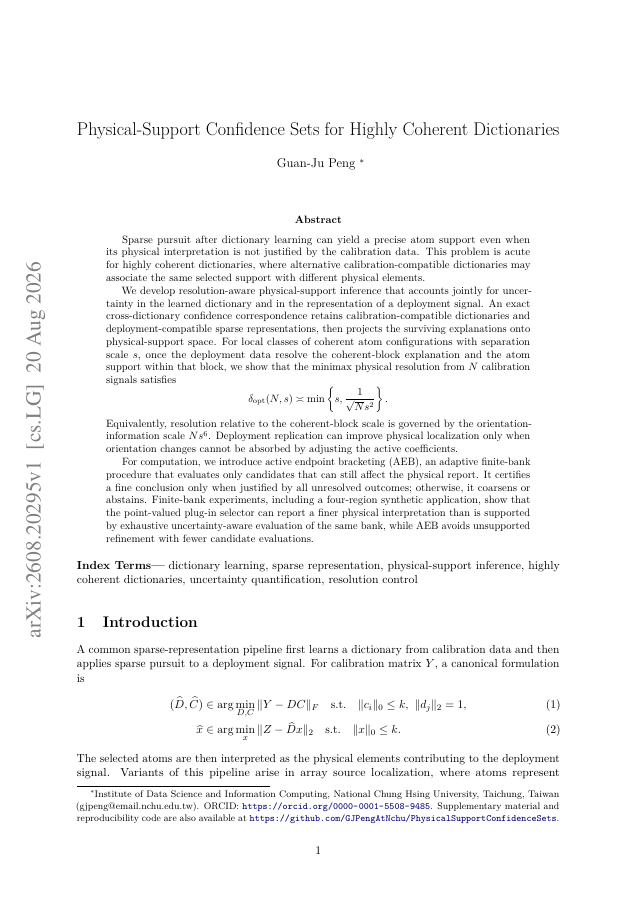
Sparse pursuit after dictionary learning can yield a precise atom support even when its physical interpretation is not justified by the calibration data, especially for highly coherent dictionaries where alternative calibration-compatible dictionaries may assign different physical meanings to the same selected support. We develop resolution-aware physical-support inference that jointly accounts for uncertainty in the learned dictionary and in the representation of a deployment signal. Our cross-dictionary confidence correspondence retains calibration-compatible dictionaries and deployment-compatible sparse representations, then projects the surviving explanations onto physical-support space. For local coherent-atom classes with separation scale s, once the deployment data resolve the coherent-block explanation and its atom support, the minimax physical resolution from N calibration signals satisfies δ_{opt}(N,s)\asymp\min{s,\frac{1}{\sqrt{N}s^2}}, with relative resolution governed by the orientation-information scale Ns^6. Deployment replication improves physical localization only when orientation changes cannot be absorbed by adjusting the active coefficients. For computation, we introduce active endpoint bracketing (AEB), an adaptive finite-bank procedure that evaluates only candidates that can still affect the physical report and otherwise safely coarsens or abstains. Finite-bank experiments, including a four-region synthetic application, show that a point-valued plug-in selector can be physically overprecise, whereas AEB avoids unsupported refinement with fewer candidate evaluations.
Physical-Support Confidence Sets for Highly Coherent Dictionaries
Sparse pursuit after dictionary learning can yield a precise atom support even when its physical interpretation is not justified by the calibration data, especially for highly coherent dictionaries where alternative calibration-compatible dictionaries may assign different…
- Preview
- Year
- 2026
- Hosting
- Full text hostedCC-BY-4.0
Cite
Notes
Only stored in your browser.
Attribution
- Abstract & full text
- arxiv.org/abs/2608.20295CC-BY-4.0
- TL;DR
- Semantic Scholar