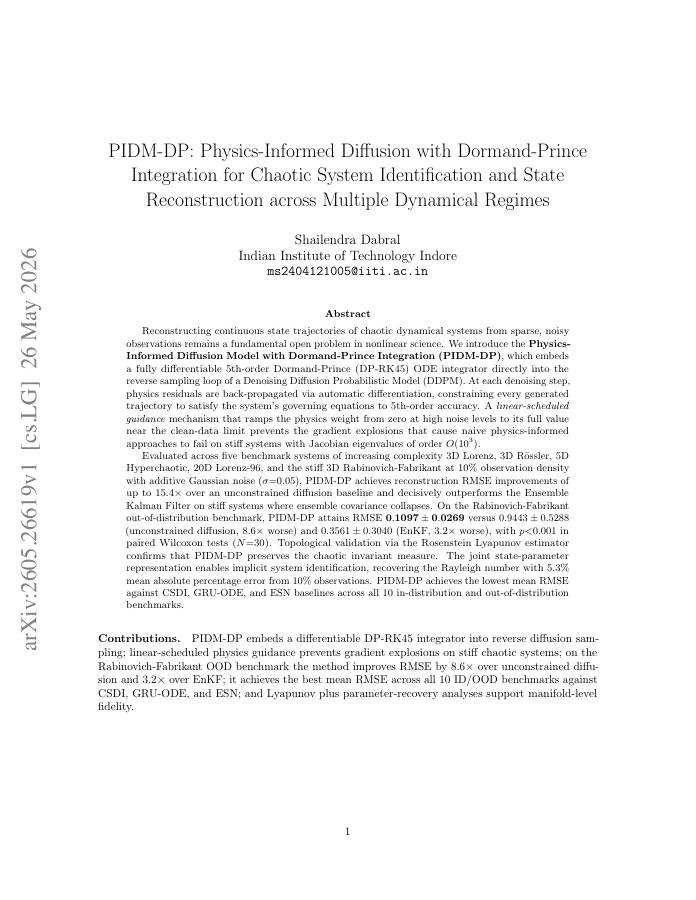
Reconstructing continuous state trajectories of chaotic dynamical systems from sparse, noisy observations remains a fundamental open problem in nonlinear science. We introduce the Physics-Informed Diffusion Model with Dormand-Prince Integration (PIDM-DP), which embeds a fully differentiable 5th-order Dormand-Prince (DP-RK45) ODE integrator directly into the reverse sampling loop of a Denoising Diffusion Probabilistic Model (DDPM). At each denoising step, physics residuals are back-propagated via automatic differentiation, constraining every generated trajectory to satisfy the system's governing equations to 5th-order accuracy. A linear-scheduled guidance mechanism that ramps the physics weight from zero at high noise levels to its full value near the clean-data limit prevents the gradient explosions that cause naive physics-informed approaches to fail on stiff systems with Jacobian eigenvalues of order O(10^3). Evaluated across five benchmark systems of increasing complexity 3D Lorenz, 3D Rössler, 5D Hyperchaotic, 20D Lorenz-96, and the stiff 3D Rabinovich-Fabrikant at 10% observation density with additive Gaussian noise (σ=0.05), PIDM-DP achieves reconstruction RMSE improvements of up to 15.4\times over an unconstrained diffusion baseline and decisively outperforms the Ensemble Kalman Filter on stiff systems where ensemble covariance collapses. On the Rabinovich-Fabrikant out-of-distribution benchmark, PIDM-DP attains RMSE 0.1097 \pm 0.0269 versus 0.9443 \pm 0.5288 (unconstrained diffusion, 8.6\times worse) and 0.3561 \pm 0.3040 (EnKF, 3.2\times worse), with p<0.001 in paired Wilcoxon tests (N = 30). Topological validation via the Rosenstein Lyapunov estimator confirms that PIDM-DP preserves the chaotic invariant measure.
PIDM-DP: Physics-Informed Diffusion with Dormand-Prince Integration for Chaotic System Identification and State Reconstruction across Multiple Dynamical Regimes
Reconstructing continuous state trajectories of chaotic dynamical systems from sparse, noisy observations remains a fundamental open problem in nonlinear science. We introduce the Physics-Informed Diffusion Model with Dormand-Prince Integration (PIDM-DP), which embeds a fully…
- Preview
- Year
- 2026
- Hosting
- Full text hostedCC-BY-SA-4.0
Cite
Notes
Only stored in your browser.
Attribution
- Abstract & full text
- arxiv.org/abs/2605.26619CC-BY-SA-4.0
- TL;DR
- Semantic Scholar