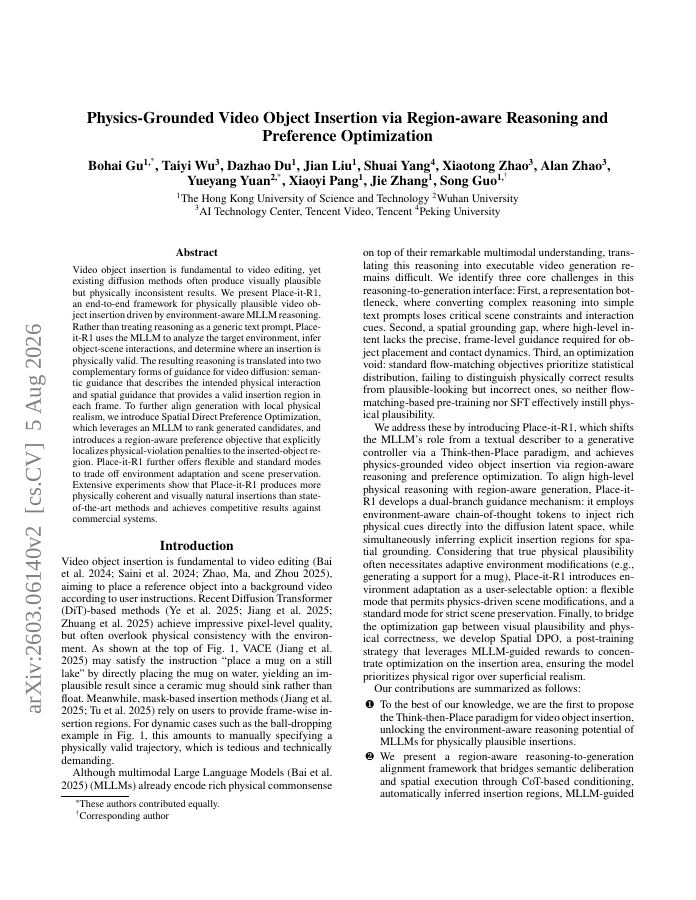
Video object insertion is fundamental to video editing, yet existing diffusion methods often produce visually plausible but physically inconsistent results. We present Place-it-R1, an end-to-end framework for physically plausible video object insertion driven by environment-aware MLLM reasoning. Rather than treating reasoning as a generic text prompt, Place-it-R1 uses the MLLM to analyze the target environment, infer object-scene interactions, and determine where an insertion is physically valid. The resulting reasoning is translated into two complementary forms of guidance for video diffusion: semantic guidance that describes the intended physical interaction and spatial guidance that provides a valid insertion region in each frame. To further align generation with local physical realism, we introduce Spatial Direct Preference Optimization, which leverages an MLLM to rank generated candidates, and introduces a region-aware preference objective that explicitly localizes physical-violation penalties to the inserted-object region. Place-it-R1 further offers flexible and standard modes to trade off environment adaptation and scene preservation. Extensive experiments show that Place-it-R1 produces more physically coherent and visually natural insertions than state-of-the-art methods and achieves competitive results against commercial systems.
Place-it-R1: Unlocking Environment-aware Reasoning Potential of MLLM for Video Object Insertion
Video object insertion is fundamental to video editing, yet existing diffusion methods often produce visually plausible but physically inconsistent results. We present Place-it-R1, an end-to-end framework for physically plausible video object insertion driven by…
- Preview
- Year
- 2026
- Hosting
- Full text hostedCC-BY-4.0
Cite
Notes
Only stored in your browser.
Attribution
- Abstract & full text
- arxiv.org/abs/2603.06140CC-BY-4.0
- TL;DR
- Semantic Scholar