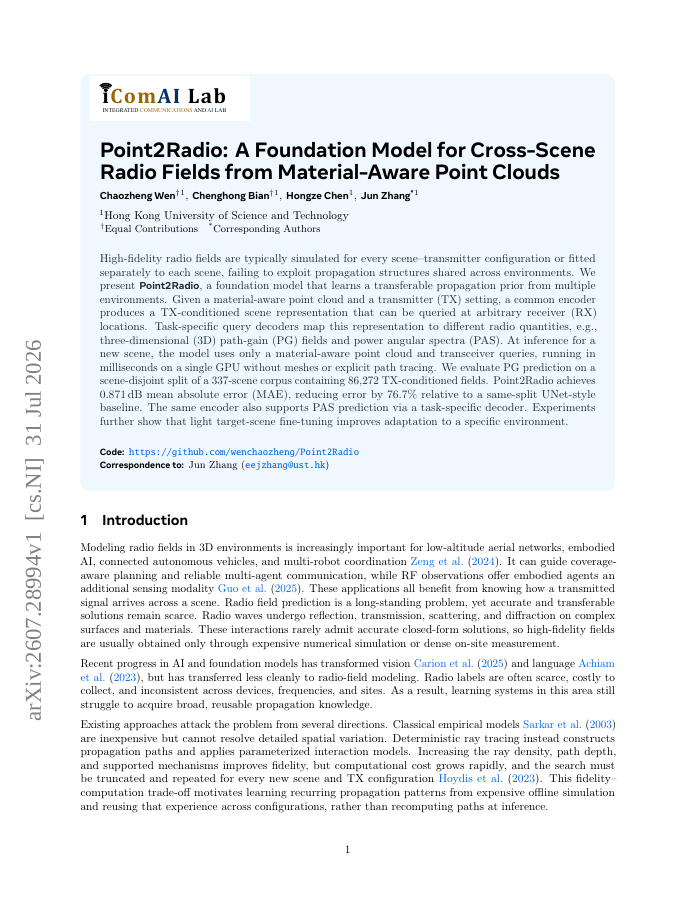
High-fidelity radio fields are typically simulated for every scene--transmitter configuration or fitted separately to each scene, failing to exploit propagation structures shared across environments. We present Point2Radio, a foundation model that learns a transferable propagation prior from multiple environments. Given a material-aware point cloud and a transmitter (TX) setting, a common encoder produces a TX-conditioned scene representation that can be queried at arbitrary receiver (RX) locations. Task-specific query decoders map this representation to different radio quantities, e.g., three-dimensional (3D) path-gain (PG) fields and power angular spectra (PAS). At inference for a new scene, the model uses only a material-aware point cloud and transceiver queries, running in milliseconds on a single GPU without meshes or explicit path tracing. We evaluate PG prediction on a scene-disjoint split of a 337-scene corpus containing 86,272 TX-conditioned fields. Point2Radio achieves 0.871 dB mean absolute error (MAE), reducing error by 76.7% relative to a same-split UNet-style baseline. The same encoder also supports PAS prediction via a task-specific decoder. Experiments further show that light target-scene fine-tuning improves adaptation to a specific environment.
Point2Radio: A Foundation Model for Cross-Scene Radio Fields from Material-Aware Point Clouds
High-fidelity radio fields are typically simulated for every scene--transmitter configuration or fitted separately to each scene, failing to exploit propagation structures shared across environments.
- Preview
- Year
- 2026
- Hosting
- Full text hostedCC-BY-4.0
Cite
Notes
Only stored in your browser.
Attribution
- Abstract & full text
- arxiv.org/abs/2607.28994CC-BY-4.0
- TL;DR
- Semantic Scholar