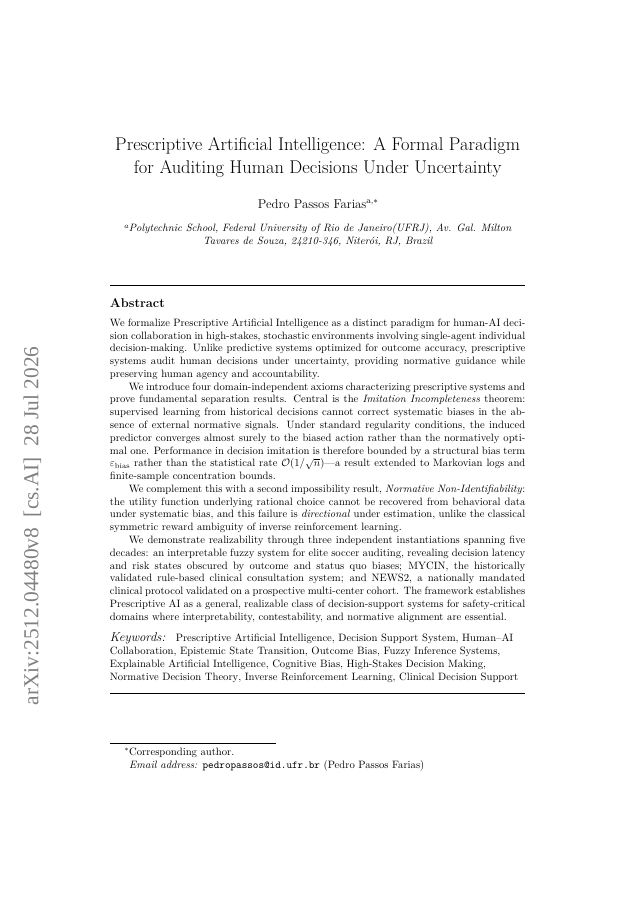
We formalize Prescriptive Artificial Intelligence as a distinct paradigm for human-AI decision collaboration in high-stakes, stochastic environments involving single-agent individual decision-making. Unlike predictive systems optimized for outcome accuracy, prescriptive systems audit human decisions under uncertainty, providing normative guidance while preserving human agency and accountability. We introduce four domain-independent axioms characterizing prescriptive systems and prove fundamental separation results. Central is the Imitation Incompleteness theorem: supervised learning from historical decisions cannot correct systematic biases in the absence of external normative signals. Under standard regularity conditions, the induced predictor converges almost surely to the biased action rather than the normatively optimal one. Performance in decision imitation is therefore bounded by a structural bias term (epsilon_bias) rather than the statistical rate O(1/sqrt(n)), a result extended to Markovian logs and finite-sample concentration bounds. We demonstrate realizability through three independent instantiations spanning five decades: an interpretable fuzzy system for elite soccer auditing, revealing decision latency and risk states obscured by outcome and status quo biases; MYCIN, the historically validated rule-based clinical consultation system; and NEWS2, a nationally mandated clinical protocol validated on a prospective multi-center cohort. The framework establishes Prescriptive AI as a general, realizable class of decision-support systems for safety-critical domains where interpretability, contestability, and normative alignment are essential.
Prescriptive Artificial Intelligence: A Formal Paradigm for Auditing Human Decisions Under Uncertainty
We formalize Prescriptive Artificial Intelligence as a distinct paradigm for human-AI decision collaboration in high-stakes, stochastic environments involving single-agent individual decision-making.
- Preview
- Year
- 2025
- Hosting
- Excerpt onlyCC-BY-NC-SA-4.0
Cite
Notes
Only stored in your browser.
Attribution
- Abstract & full text
- arxiv.org/abs/2512.04480CC-BY-NC-SA-4.0
- TL;DR
- Semantic Scholar