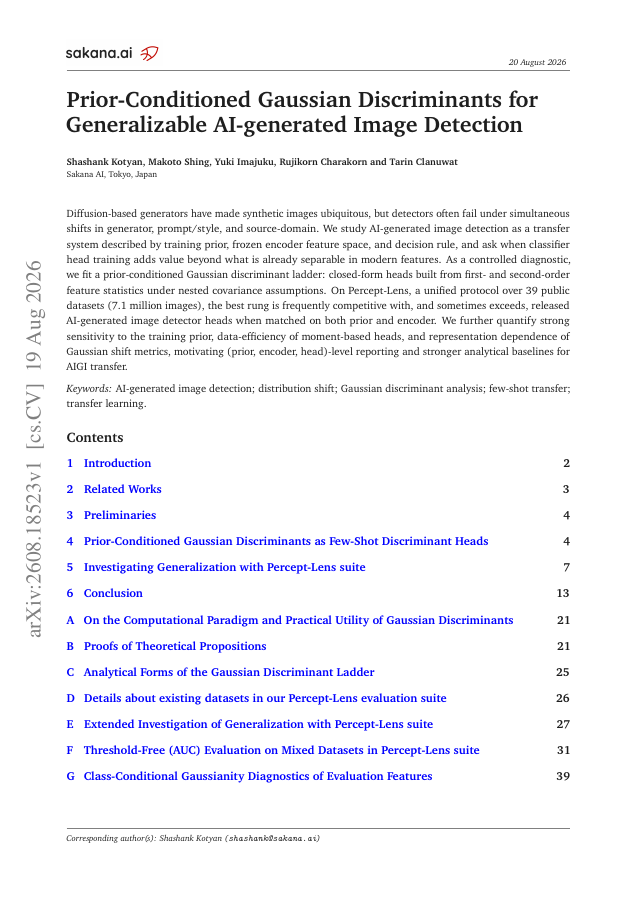
Diffusion-based generators have made synthetic images ubiquitous, but detectors often fail under simultaneous shifts in generator, prompt/style, and source-domain. We study AI-generated image detection as a transfer system described by training prior, frozen encoder feature space, and decision rule, and ask when classifier head training adds value beyond what is already separable in modern features. As a controlled diagnostic, we fit a prior-conditioned Gaussian discriminant ladder: closed-form heads built from first- and second-order feature statistics under nested covariance assumptions. On Percept-Lens, a unified protocol over 39 public datasets (7.1 million images), the best rung is frequently competitive with, and sometimes exceeds, released AI-generated image detector heads when matched on both prior and encoder. We further quantify strong sensitivity to the training prior, data-efficiency of moment-based heads, and representation dependence of Gaussian shift metrics, motivating (prior, encoder, head)-level reporting and stronger analytical baselines for AIGI transfer.
Prior-Conditioned Gaussian Discriminants for Generalizable AI-generated Image Detection
Diffusion-based generators have made synthetic images ubiquitous, but detectors often fail under simultaneous shifts in generator, prompt/style, and source-domain. We study AI-generated image detection as a transfer system described by training prior, frozen encoder feature…
- Preview
- Year
- 2026
- Hosting
- Excerpt onlyCC-BY-NC-SA-4.0
Cite
Notes
Only stored in your browser.
Attribution
- Abstract & full text
- arxiv.org/abs/2608.18523CC-BY-NC-SA-4.0
- TL;DR
- Semantic Scholar