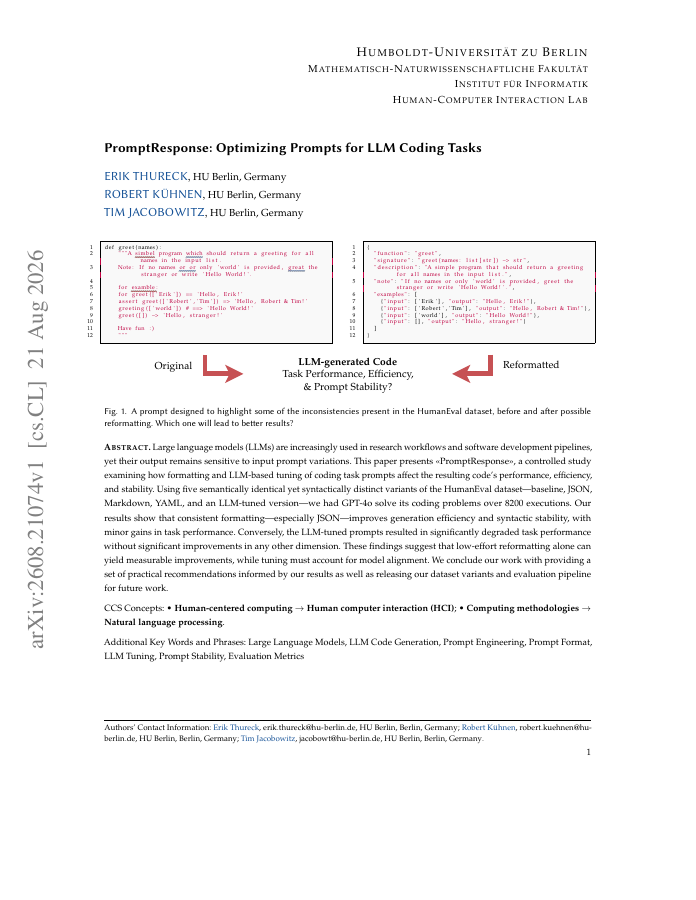
Large language models (LLMs) are increasingly used in research workflows and software development pipelines, yet their output remains sensitive to input prompt variations. This paper presents \unicode{x00AB}PromptResponse\unicode{x00BB}, a controlled study examining how formatting and LLM-based tuning of coding task prompts affect the resulting code's performance, efficiency, and stability. Using five semantically identical yet syntactically distinct variants of the HumanEval dataset\unicode{x2014}baseline, JSON, Markdown, YAML, and an LLM-tuned version\unicode{x2014}we had GPT-4o solve its coding problems over 8200\unicode{x00A0}executions. Our results show that consistent formatting\unicode{x2014}especially JSON\unicode{x2014}improves generation efficiency and syntactic stability, with minor gains in task performance. Conversely, the LLM-tuned prompts resulted in significantly degraded task performance without significant improvements in any other dimension. These findings suggest that low-effort reformatting alone can yield measurable improvements, while tuning must account for model alignment. We conclude our work with providing a set of practical recommendations informed by our results as well as releasing our dataset variants and evaluation pipeline for future work.
PromptResponse: Optimizing Prompts for LLM Coding Tasks
Large language models (LLMs) are increasingly used in research workflows and software development pipelines, yet their output remains sensitive to input prompt variations.
- Preview
- Year
- 2026
- Hosting
- Full text hostedCC-BY-SA-4.0
Cite
Notes
Only stored in your browser.
Attribution
- Abstract & full text
- arxiv.org/abs/2608.21074CC-BY-SA-4.0
- TL;DR
- Semantic Scholar