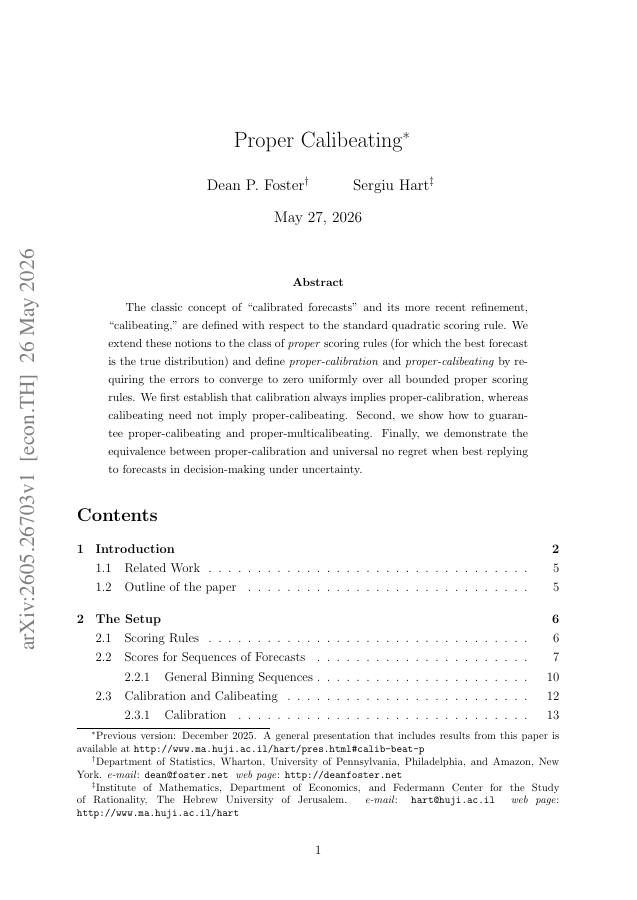
The classic concept of "calibrated forecasts" and its more recent refinement, "calibeating," are defined with respect to the standard quadratic scoring rule. We extend these notions to the class of proper scoring rules (for which the best forecast is the true distribution) and define proper-calibration and proper-calibeating by requiring the errors to converge to zero uniformly over all bounded proper scoring rules. We first establish that calibration always implies proper-calibration, whereas calibeating need not imply proper-calibeating. Second, we show how to guarantee proper-calibeating and proper-multicalibeating. Finally, we demonstrate the equivalence between proper-calibration and universal no regret when best replying to forecasts in decision-making under uncertainty.
Proper Calibeating
The classic concept of "calibrated forecasts" and its more recent refinement, "calibeating," are defined with respect to the standard quadratic scoring rule.
- Preview
- Year
- 2026
- Hosting
- Full text hostedCC-BY-4.0
Cite
Notes
Only stored in your browser.
Attribution
- Abstract & full text
- arxiv.org/abs/2605.26703CC-BY-4.0
- TL;DR
- Semantic Scholar