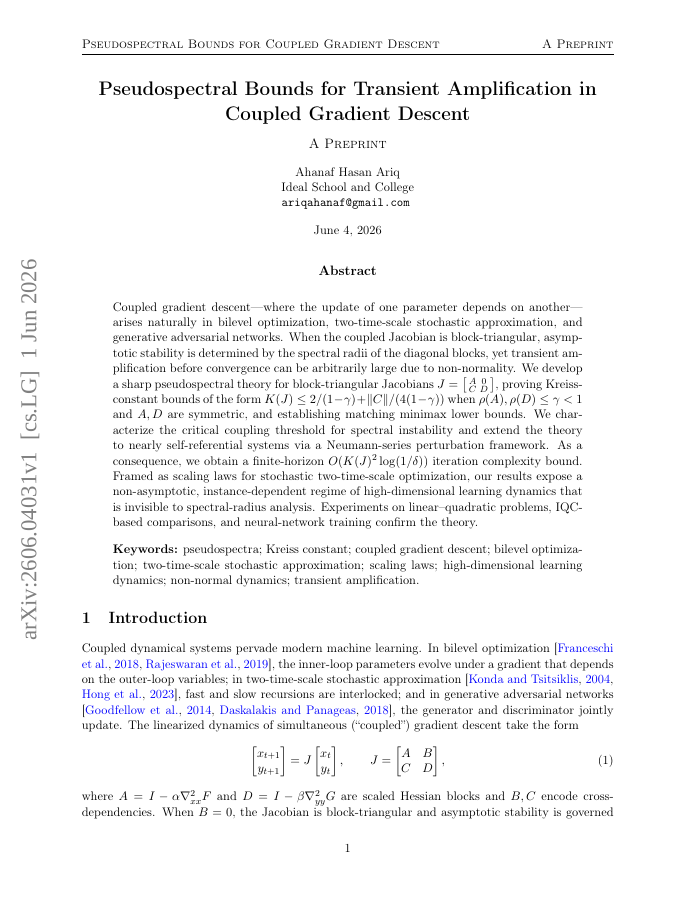
Coupled gradient descent - where the update of one parameter depends on another - arises naturally in bilevel optimization, two-time-scale stochastic approximation, and generative adversarial networks. When the coupled Jacobian is block-triangular, asymptotic stability is determined by the spectral radii of the diagonal blocks, yet transient amplification before convergence can be arbitrarily large due to non-normality. We develop a sharp pseudospectral theory for block-triangular Jacobians J = [[A, 0], [C, D]], proving Kreiss-constant bounds of the form K(J) <= 2/(1-γ) + ||C||/(4(1-γ)) when ρ(A), ρ(D) <= γ< 1 and A, D are symmetric, and establishing matching minimax lower bounds. We characterize the critical coupling threshold for spectral instability and extend the theory to nearly self-referential systems via a Neumann-series perturbation framework. As a consequence, we obtain a finite-horizon O(K(J)^2 log(1/δ)) iteration complexity bound. Framed as scaling laws for stochastic two-time-scale optimization, our results expose a non-asymptotic, instance-dependent regime of high-dimensional learning dynamics that is invisible to spectral-radius analysis. Experiments on linear-quadratic problems, IQC-based comparisons, and neural-network training confirm the theory.
Pseudospectral Bounds for Transient Amplification in Coupled Gradient Descent
Coupled gradient descent - where the update of one parameter depends on another - arises naturally in bilevel optimization, two-time-scale stochastic approximation, and generative adversarial networks.
- Preview
- Year
- 2026
- Hosting
- Full text hostedCC-BY-4.0
Cite
Notes
Only stored in your browser.
Attribution
- Abstract & full text
- arxiv.org/abs/2606.04031CC-BY-4.0
- TL;DR
- Semantic Scholar