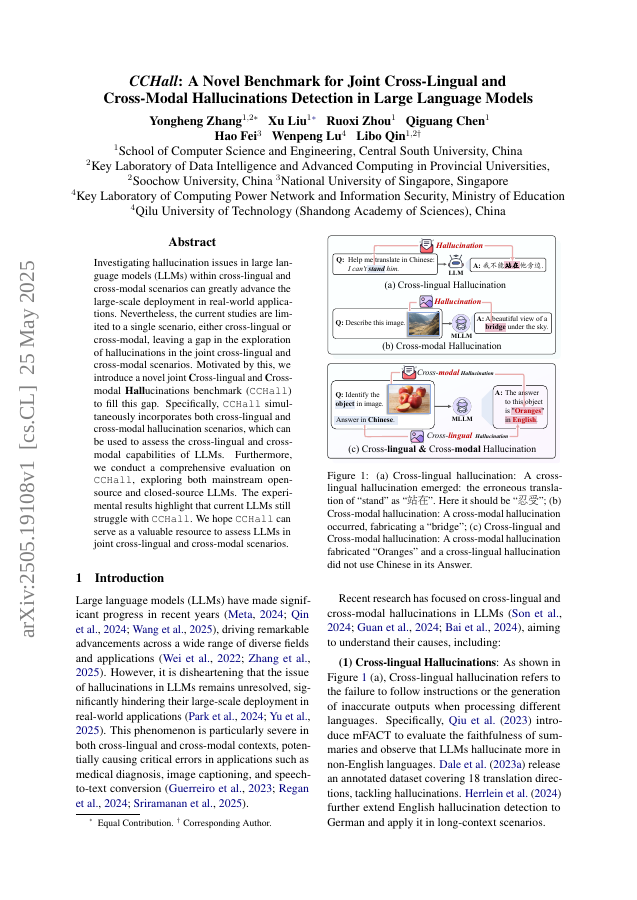
Investigating hallucination issues in large language models (LLMs) within cross-lingual and cross-modal scenarios can greatly advance the large-scale deployment in real-world applications. Nevertheless, the current studies are limited to a single scenario, either cross-lingual or cross-modal, leaving a gap in the exploration of hallucinations in the joint cross-lingual and cross-modal scenarios. Motivated by this, we introduce a novel joint Cross-lingual and Cross-modal Hallucinations benchmark (CCHall) to fill this gap. Specifically, CCHall simultaneously incorporates both cross-lingual and cross-modal hallucination scenarios, which can be used to assess the cross-lingual and cross-modal capabilities of LLMs. Furthermore, we conduct a comprehensive evaluation on CCHall, exploring both mainstream open-source and closed-source LLMs. The experimental results highlight that current LLMs still struggle with CCHall. We hope CCHall can serve as a valuable resource to assess LLMs in joint cross-lingual and cross-modal scenarios.
CCHall: A Novel Benchmark for Joint Cross-Lingual and Cross-Modal Hallucinations Detection in Large Language Models
A new benchmark, CCHall, assesses hallucinations in both cross-lingual and cross-modal scenarios for large language models, revealing their limitations.
- Preview
- Year
- 2025
- Venue
- arXiv 2025
- Authors
- 7
- Hosting
- Abstract onlyARXIV-DEFAULT
Cite
Notes
Only stored in your browser.
Attribution
- Abstract & full text
- arxiv.org/abs/2505.19108ARXIV-DEFAULT
- TL;DR
- Semantic Scholar