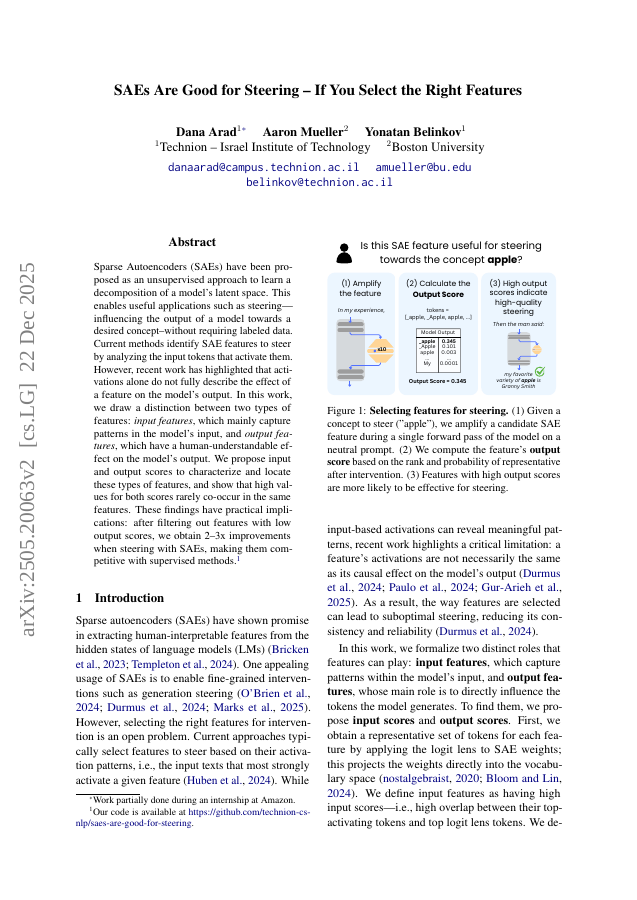
Sparse Autoencoders (SAEs) have been proposed as an unsupervised approach to learn a decomposition of a model's latent space. This enables useful applications such as steering - influencing the output of a model towards a desired concept - without requiring labeled data. Current methods identify SAE features to steer by analyzing the input tokens that activate them. However, recent work has highlighted that activations alone do not fully describe the effect of a feature on the model's output. In this work, we draw a distinction between two types of features: input features, which mainly capture patterns in the model's input, and output features, which have a human-understandable effect on the model's output. We propose input and output scores to characterize and locate these types of features, and show that high values for both scores rarely co-occur in the same features. These findings have practical implications: after filtering out features with low output scores, we obtain 2-3x improvements when steering with SAEs, making them competitive with supervised methods.
SAEs Are Good for Steering -- If You Select the Right Features
Sparse Autoencoders are used for learning latent space decompositions that enable model steering based on input features and human-understandable output features.
- Preview
- Year
- 2025
- Venue
- arXiv 2025
- Authors
- 3
- Hosting
- Abstract onlyARXIV-DEFAULT
Cite
Notes
Only stored in your browser.
Attribution
- Abstract & full text
- arxiv.org/abs/2505.20063ARXIV-DEFAULT
- TL;DR
- Semantic Scholar