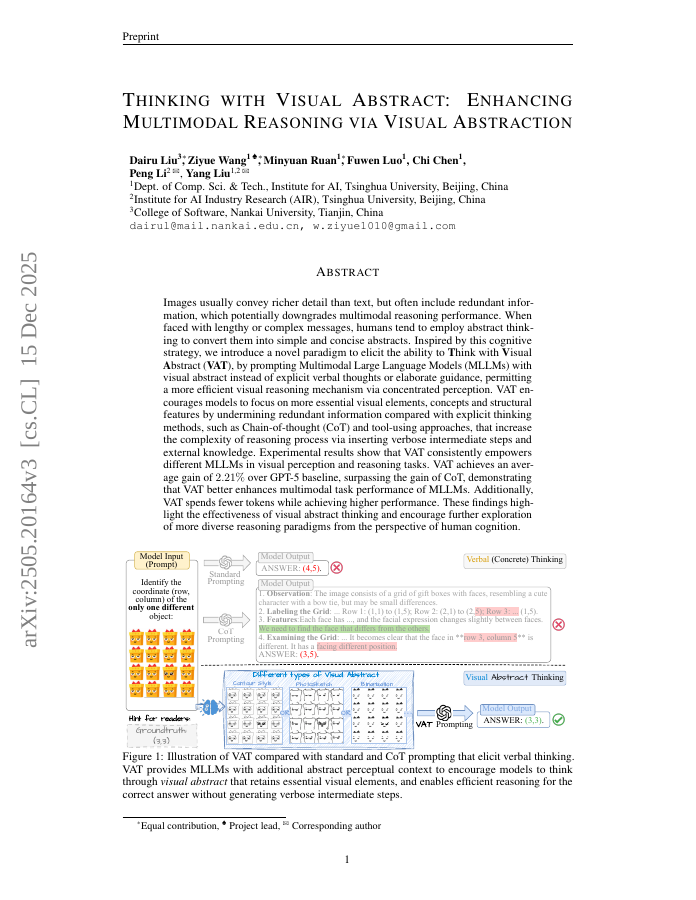
Images usually convey richer detail than text, but often include redundant information which potentially downgrades multimodal reasoning performance. When faced with lengthy or complex messages, humans tend to employ abstract thinking to convert them into simple and concise abstracts. Inspired by this cognitive strategy, we introduce Visual Abstract Thinking (VAT), a novel thinking paradigm that prompts Multimodal Large Language Models (MLLMs) with visual abstract instead of explicit verbal thoughts or elaborate guidance, permitting a more concentrated visual reasoning mechanism. Explicit thinking, such as Chain-of-thought (CoT) or tool-augmented approaches, increases the complexity of reasoning process via inserting verbose intermediate steps, external knowledge or visual information. In contrast, VAT reduces redundant visual information and encourages models to focus their reasoning on more essential visual elements. Experimental results show that VAT consistently empowers different models, and achieves an average gain of 17% over GPT-4o baseline by employing diverse types of visual abstracts, demonstrating that VAT can enhance visual reasoning abilities for MLLMs regarding conceptual, structural and relational reasoning tasks. VAT is also compatible with CoT in knowledge-intensive multimodal reasoning tasks. These findings highlight the effectiveness of visual reasoning via abstract thinking and encourage further exploration of more diverse reasoning paradigms from the perspective of human cognition.
Visual Abstract Thinking Empowers Multimodal Reasoning
Visual Abstract Thinking (VAT) enhancesMultimodal Large Language Models' (MLLMs) visual reasoning by focusing on essential visual elements through abstracts, outperforming explicit methods like Chain-of-thought.
- Preview
- Year
- 2025
- Venue
- arXiv 2025
- Authors
- 7
- Hosting
- Abstract onlyARXIV-DEFAULT
Cite
Notes
Only stored in your browser.
Attribution
- Abstract & full text
- arxiv.org/abs/2505.20164ARXIV-DEFAULT
- TL;DR
- Semantic Scholar