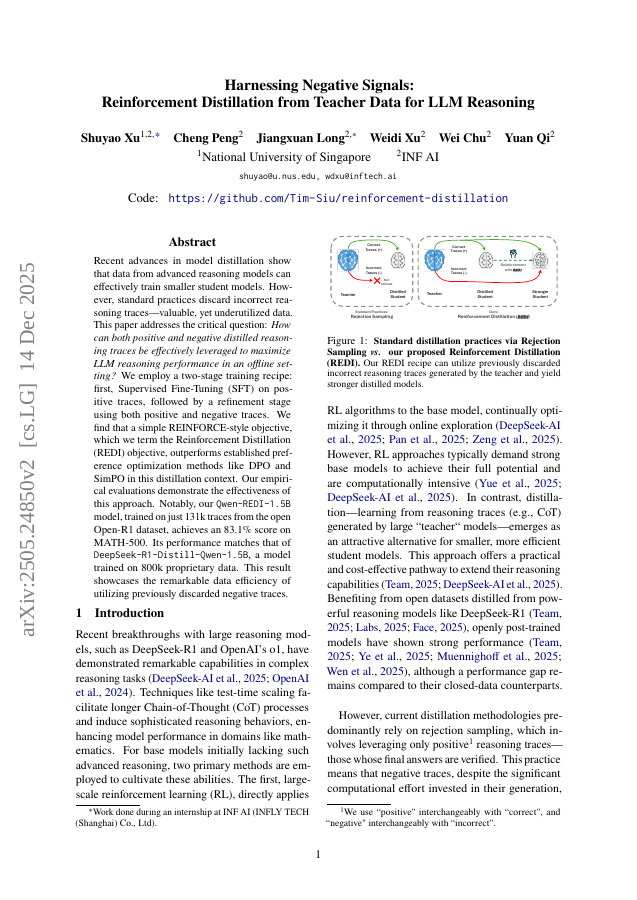
Recent advances in model distillation demonstrate that data from advanced reasoning models (e.g., DeepSeek-R1, OpenAI's o1) can effectively transfer complex reasoning abilities to smaller, efficient student models. However, standard practices employ rejection sampling, discarding incorrect reasoning examples -- valuable, yet often underutilized data. This paper addresses the critical question: How can both positive and negative distilled reasoning traces be effectively leveraged to maximize LLM reasoning performance in an offline setting? To this end, We propose Reinforcement Distillation (REDI), a two-stage framework. Stage 1 learns from positive traces via Supervised Fine-Tuning (SFT). Stage 2 further refines the model using both positive and negative traces through our proposed REDI objective. This novel objective is a simple, reference-free loss function that outperforms established methods like DPO and SimPO in this distillation context. Our empirical evaluations demonstrate REDI's superiority over baseline Rejection Sampling SFT or SFT combined with DPO/SimPO on mathematical reasoning tasks. Notably, the Qwen-REDI-1.5B model, post-trained on just 131k positive and negative examples from the open Open-R1 dataset, achieves an 83.1% score on MATH-500 (pass@1). Its performance matches or surpasses that of DeepSeek-R1-Distill-Qwen-1.5B (a model post-trained on 800k proprietary data) across various mathematical reasoning benchmarks, establishing a new state-of-the-art for 1.5B models post-trained offline with openly available data.
Harnessing Negative Signals: Reinforcement Distillation from Teacher Data for LLM Reasoning
Reinforcement Distillation (REDI) leverages both positive and negative traces to enhance large language model reasoning performance offline, outperforming traditional methods and achieving state-of-the-art results with limited open data.
- Preview
- Year
- 2025
- Venue
- arXiv 2025
- Authors
- 6
- Hosting
- Abstract onlyARXIV-DEFAULT
Cite
Notes
Only stored in your browser.
Attribution
- Abstract & full text
- arxiv.org/abs/2505.24850ARXIV-DEFAULT
- TL;DR
- Semantic Scholar