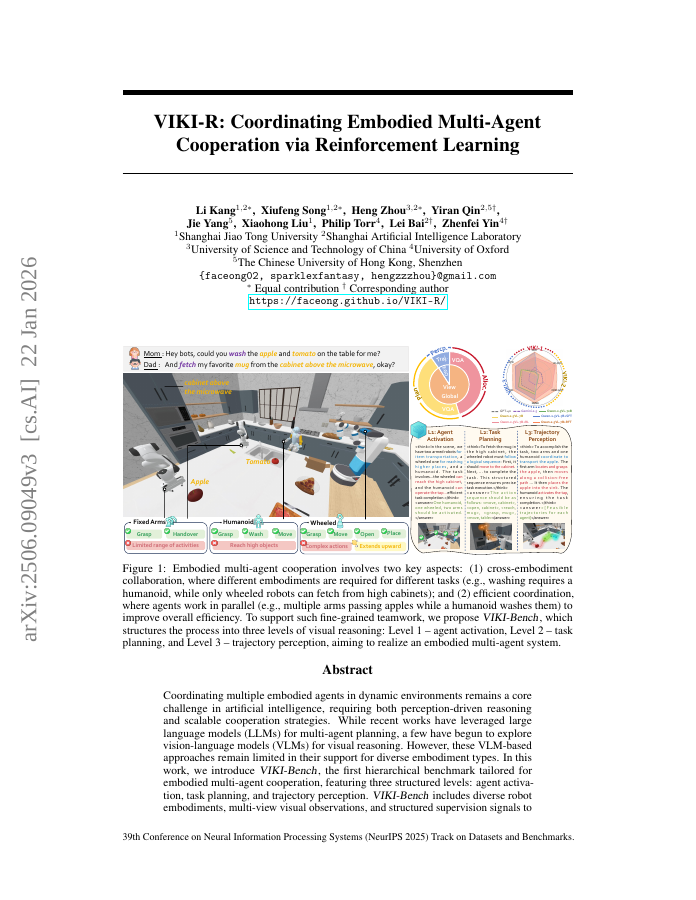
Coordinating multiple embodied agents in dynamic environments remains a core challenge in artificial intelligence, requiring both perception-driven reasoning and scalable cooperation strategies. While recent works have leveraged large language models (LLMs) for multi-agent planning, a few have begun to explore vision-language models (VLMs) for visual reasoning. However, these VLM-based approaches remain limited in their support for diverse embodiment types. In this work, we introduce VIKI-Bench, the first hierarchical benchmark tailored for embodied multi-agent cooperation, featuring three structured levels: agent activation, task planning, and trajectory perception. VIKI-Bench includes diverse robot embodiments, multi-view visual observations, and structured supervision signals to evaluate reasoning grounded in visual inputs. To demonstrate the utility of VIKI-Bench, we propose VIKI-R, a two-stage framework that fine-tunes a pretrained vision-language model (VLM) using Chain-of-Thought annotated demonstrations, followed by reinforcement learning under multi-level reward signals. Our extensive experiments show that VIKI-R significantly outperforms baselines method across all task levels. Furthermore, we show that reinforcement learning enables the emergence of compositional cooperation patterns among heterogeneous agents. Together, VIKI-Bench and VIKI-R offer a unified testbed and method for advancing multi-agent, visual-driven cooperation in embodied AI systems.
VIKI-R: Coordinating Embodied Multi-Agent Cooperation via Reinforcement Learning
Coordinating multiple embodied agents in dynamic environments remains a core challenge in artificial intelligence, requiring both perception-driven reasoning and scalable cooperation strategies.
- Preview
- Year
- 2025
- Venue
- arXiv 2025
- Authors
- 9
- Hosting
- Abstract onlyARXIV-DEFAULT
Cite
Notes
Only stored in your browser.
Attribution
- Abstract & full text
- arxiv.org/abs/2506.09049ARXIV-DEFAULT
- TL;DR
- Semantic Scholar