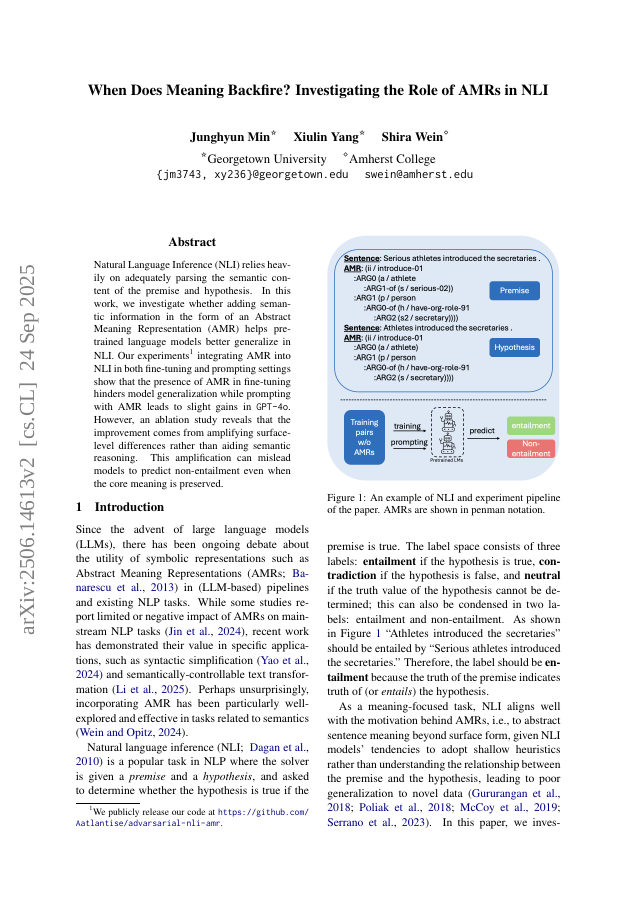
Natural Language Inference (NLI) relies heavily on adequately parsing the semantic content of the premise and hypothesis. In this work, we investigate whether adding semantic information in the form of an Abstract Meaning Representation (AMR) helps pretrained language models better generalize in NLI. Our experiments integrating AMR into NLI in both fine-tuning and prompting settings show that the presence of AMR in fine-tuning hinders model generalization while prompting with AMR leads to slight gains in GPT-4o. However, an ablation study reveals that the improvement comes from amplifying surface-level differences rather than aiding semantic reasoning. This amplification can mislead models to predict non-entailment even when the core meaning is preserved.
When Does Meaning Backfire? Investigating the Role of AMRs in NLI
Adding Abstract Meaning Representation (AMR) to pretrained language models for Natural Language Inference (NLI) shows mixed results, with fine-tuning hindering generalization and prompting slightly improving performance but primarily by amplifying surface-level differences.
- Preview
- Year
- 2025
- Venue
- arXiv 2025
- Authors
- 3
- Hosting
- Abstract onlyARXIV-DEFAULT
Cite
Notes
Only stored in your browser.
Attribution
- Abstract & full text
- arxiv.org/abs/2506.14613ARXIV-DEFAULT
- TL;DR
- Semantic Scholar