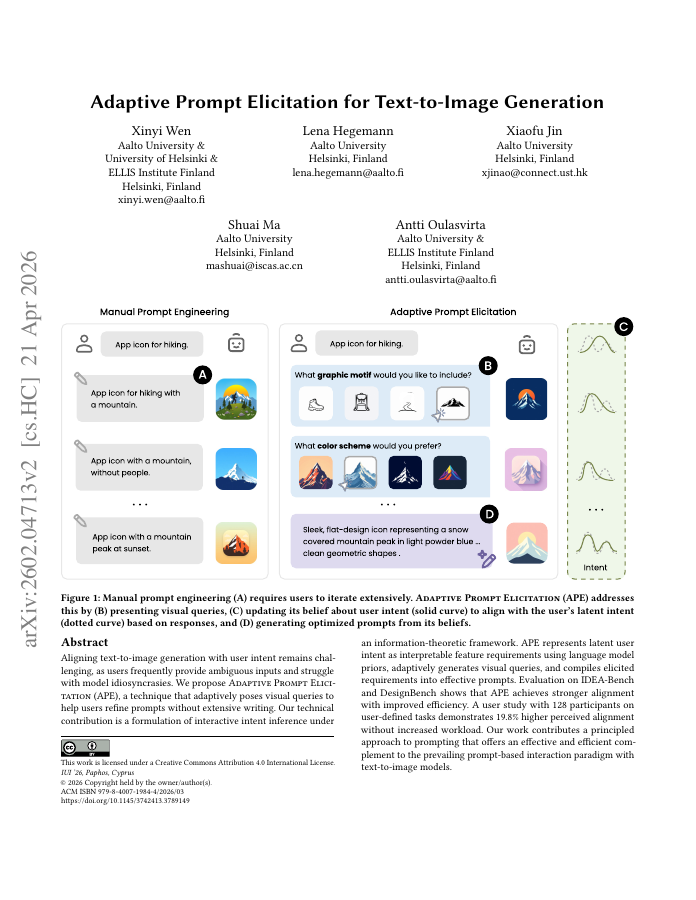
Aligning text-to-image generation with user intent remains challenging, for users who provide ambiguous inputs and struggle with model idiosyncrasies. We propose Adaptive Prompt Elicitation (APE), a technique that adaptively asks visual queries to help users refine prompts without extensive writing. Our technical contribution is a formulation of interactive intent inference under an information-theoretic framework. APE represents latent intent as interpretable feature requirements using language model priors, adaptively generates visual queries, and compiles elicited requirements into effective prompts. Evaluation on IDEA-Bench and DesignBench shows that APE achieves stronger alignment with improved efficiency. A user study with challenging user-defined tasks demonstrates 19.8% higher alignment without workload overhead. Our work contributes a principled approach to prompting that, for general users, offers an effective and efficient complement to the prevailing prompt-based interaction paradigm with text-to-image models.
Adaptive Prompt Elicitation for Text-to-Image Generation
Adaptive Prompt Elicitation (APE) improves text-to-image generation alignment by adaptively querying users visually and compiling elicited requirements into effective prompts using language model priors and information-theoretic framework.
- Preview
- Year
- 2026
- Venue
- arXiv 2026
- Authors
- 5
- Hosting
- Abstract onlyARXIV-DEFAULT
Cite
Notes
Only stored in your browser.
Attribution
- Abstract & full text
- arxiv.org/abs/2602.04713ARXIV-DEFAULT
- TL;DR
- Semantic Scholar