Expanding multimodal representations to novel modalities is constrained by reliance on large-scale paired datasets (e.g., text-image, text-audio, text-3D, text-molecule), which are costly and often infeasible in domains requiring expert annotation such as medical imaging and molecular analysis. We introduce TextME, the first text-only modality expansion framework, to the best of our knowledge, projecting diverse modalities into LLM embedding space as a unified anchor. Our approach exploits the geometric structure of pretrained contrastive encoders to enable zero-shot cross-modal transfer using only text descriptions, without paired supervision. We empirically validate that such consistent modality gaps exist across image, video, audio, 3D, X-ray, and molecular domains, demonstrating that text-only training can preserve substantial performance of pretrained encoders. We further show that our framework enables emergent cross-modal retrieval between modality pairs not explicitly aligned during training (e.g., audio-to-image, 3D-to-image). These results establish text-only training as a practical alternative to paired supervision for modality expansion.
TextME: Bridging Unseen Modalities Through Text Descriptions
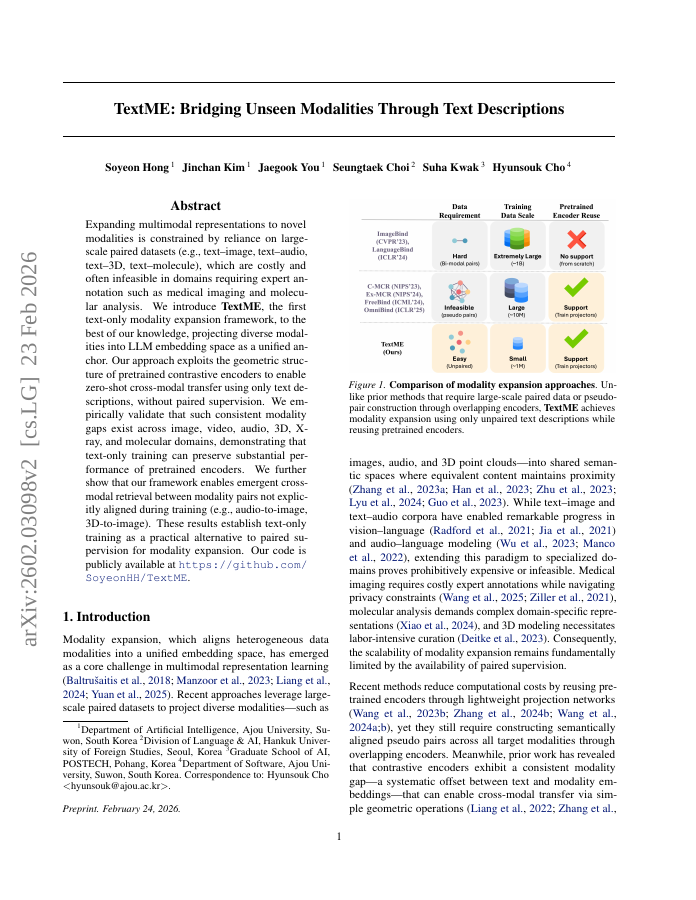
TextME enables cross-modal transfer and modality expansion by projecting diverse data types into a unified text-based embedding space without requiring paired datasets.
- Preview
- Year
- 2026
- Venue
- arXiv 2026
- Authors
- 6
- Hosting
- Abstract onlyARXIV-DEFAULT
Cite
Notes
Only stored in your browser.
Attribution
- Abstract & full text
- arxiv.org/abs/2602.03098ARXIV-DEFAULT
- TL;DR
- Semantic Scholar