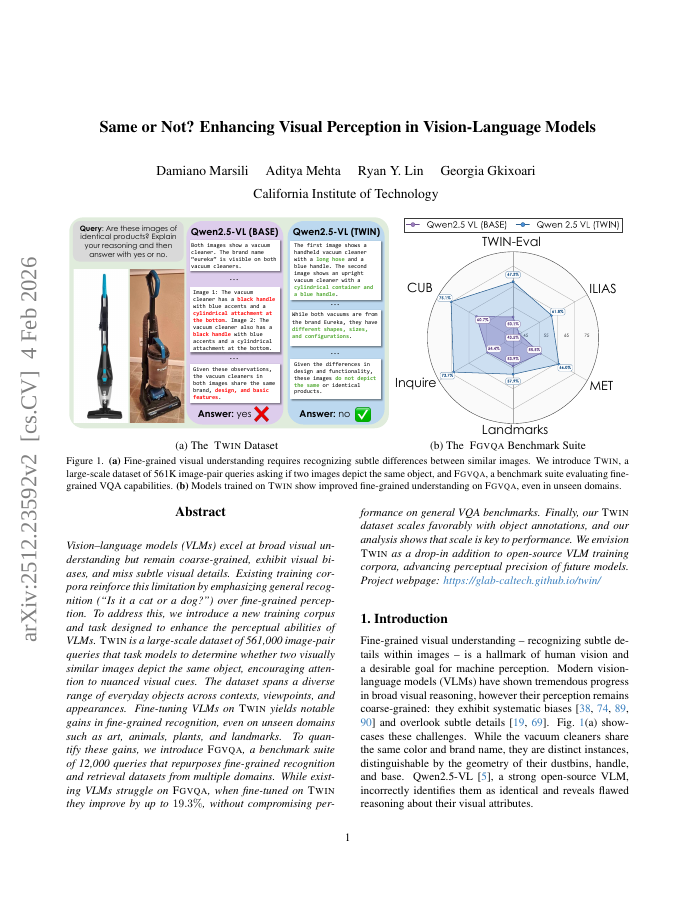
Vision-language models (VLMs) excel at broad visual understanding but remain coarse-grained, exhibit visual biases, and miss subtle visual details. Existing training corpora reinforce this limitation by emphasizing general recognition ("Is it a cat or a dog?") over fine-grained perception. To address this, we introduce a new training corpus and task designed to enhance the perceptual abilities of VLMs. TWIN is a large-scale dataset of 561,000 image-pair queries that task models to determine whether two visually similar images depict the same object, encouraging attention to nuanced visual cues. The dataset spans a diverse range of everyday objects across contexts, viewpoints, and appearances. Fine-tuning VLMs on TWIN yields notable gains in fine-grained recognition, even on unseen domains such as art, animals, plants, and landmarks. To quantify these gains, we introduce FGVQA, a benchmark suite of 12,000 queries that repurposes fine-grained recognition and retrieval datasets from multiple domains. While existing VLMs struggle on FGVQA, when fine-tuned on TWIN they improve by up to 19.3%, without compromising performance on general VQA benchmarks. Finally, our TWIN dataset scales favorably with object annotations, and our analysis shows that scale is key to performance. We envision TWIN as a drop-in addition to open-source VLM training corpora, advancing perceptual precision of future models. Project webpage: https://glab-caltech.github.io/twin/
Same or Not? Enhancing Visual Perception in Vision-Language Models
A new dataset and benchmark for fine-grained image recognition enhance vision-language models' perceptual precision through targeted training on nuanced visual distinctions.
- Preview
- Year
- 2025
- Venue
- arXiv 2025
- Authors
- 4
- Hosting
- Abstract onlyARXIV-DEFAULT
Cite
Notes
Only stored in your browser.
Attribution
- Abstract & full text
- arxiv.org/abs/2512.23592ARXIV-DEFAULT
- TL;DR
- Semantic Scholar