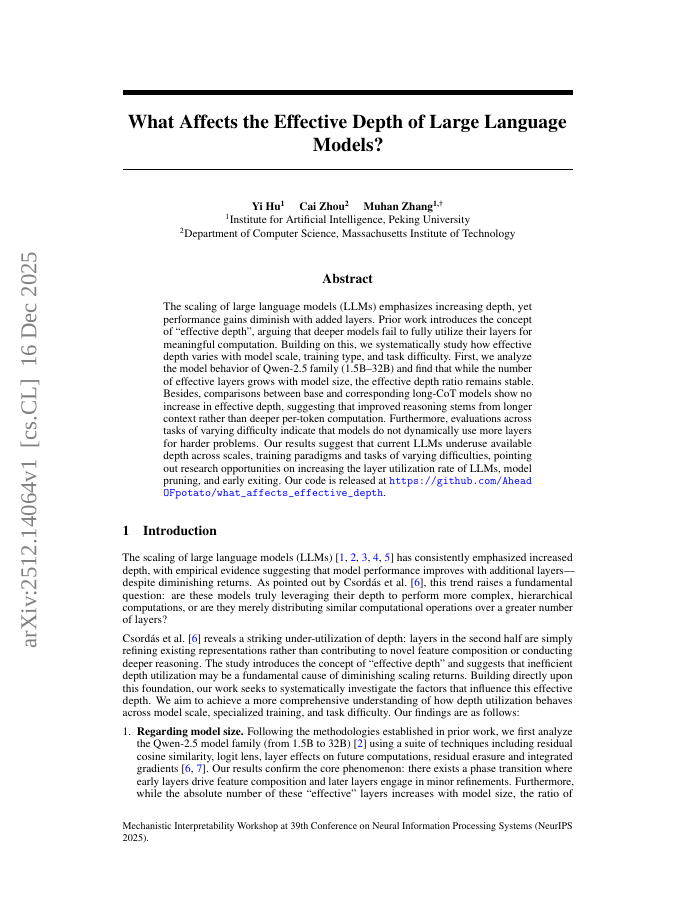
The scaling of large language models (LLMs) emphasizes increasing depth, yet performance gains diminish with added layers. Prior work introduces the concept of "effective depth", arguing that deeper models fail to fully utilize their layers for meaningful computation. Building on this, we systematically study how effective depth varies with model scale, training type, and task difficulty. First, we analyze the model behavior of Qwen-2.5 family (1.5B-32B) and find that while the number of effective layers grows with model size, the effective depth ratio remains stable. Besides, comparisons between base and corresponding long-CoT models show no increase in effective depth, suggesting that improved reasoning stems from longer context rather than deeper per-token computation. Furthermore, evaluations across tasks of varying difficulty indicate that models do not dynamically use more layers for harder problems. Our results suggest that current LLMs underuse available depth across scales, training paradigms and tasks of varying difficulties, pointing out research opportunities on increasing the layer utilization rate of LLMs, model pruning, and early exiting. Our code is released at https://github.com/AheadOFpotato/what_affects_effective_depth.
What Affects the Effective Depth of Large Language Models?
Research reveals that large language models underutilize their depth across different scales and tasks, with effective depth remaining stable despite increased model size and longer context not enhancing per-token computation.
- Preview
- Year
- 2025
- Venue
- arXiv 2025
- Authors
- 3
- Hosting
- Abstract onlyARXIV-DEFAULT
Cite
Notes
Only stored in your browser.
Attribution
- Abstract & full text
- arxiv.org/abs/2512.14064ARXIV-DEFAULT
- TL;DR
- Semantic Scholar