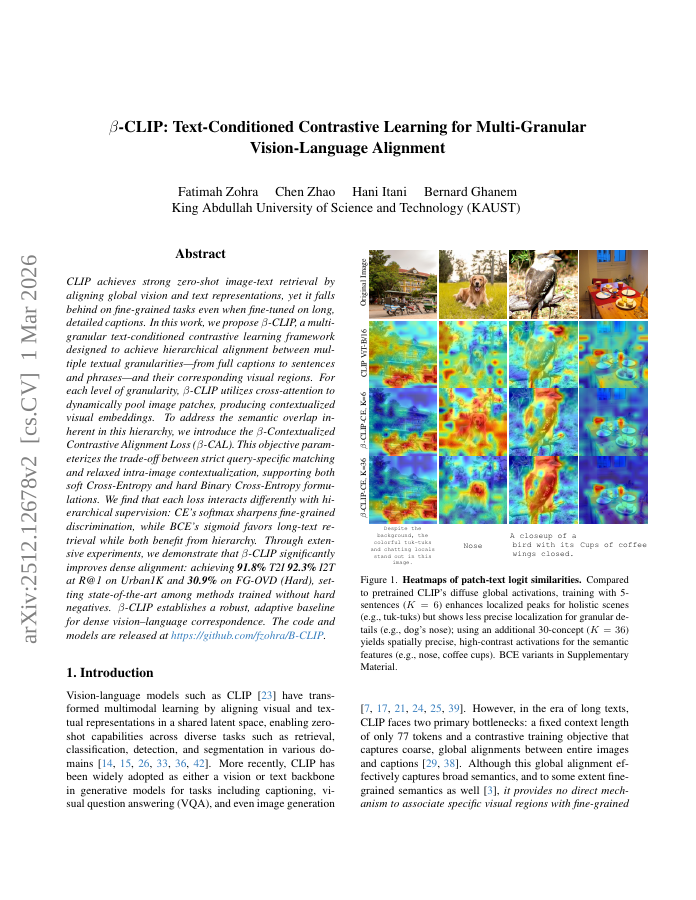
CLIP achieves strong zero-shot image-text retrieval by aligning global vision and text representations, yet it falls behind on fine-grained tasks even when fine-tuned on long, detailed captions. In this work, we propose β-CLIP, a multi-granular text-conditioned contrastive learning framework designed to achieve hierarchical alignment between multiple textual granularities-from full captions to sentences and phrases-and their corresponding visual regions. For each level of granularity, β-CLIP utilizes cross-attention to dynamically pool image patches, producing contextualized visual embeddings. To address the semantic overlap inherent in this hierarchy, we introduce the β-Contextualized Contrastive Alignment Loss (β-CAL). This objective parameterizes the trade-off between strict query-specific matching and relaxed intra-image contextualization, supporting both soft Cross-Entropy and hard Binary Cross-Entropy formulations. Through extensive experiments, we demonstrate that β-CLIP significantly improves dense alignment: achieving 91.8% T2I 92.3% I2T at R@1 on Urban1K and 30.9% on FG-OVD (Hard), setting state-of-the-art among methods trained without hard negatives. β-CLIP establishes a robust, adaptive baseline for dense vision-language correspondence. The code and models are released at https://github.com/fzohra/B-CLIP.
β-CLIP: Text-Conditioned Contrastive Learning for Multi-Granular Vision-Language Alignment
$β$-CLIP enhances zero-shot image-text retrieval by aligning multiple granularities of text with corresponding visual regions using cross-attention and a hierarchical contrastive loss.
- Preview
- Year
- 2025
- Venue
- arXiv 2025
- Authors
- 4
- Hosting
- Abstract onlyARXIV-DEFAULT
Cite
Notes
Only stored in your browser.
Attribution
- Abstract & full text
- arxiv.org/abs/2512.12678ARXIV-DEFAULT
- TL;DR
- Semantic Scholar