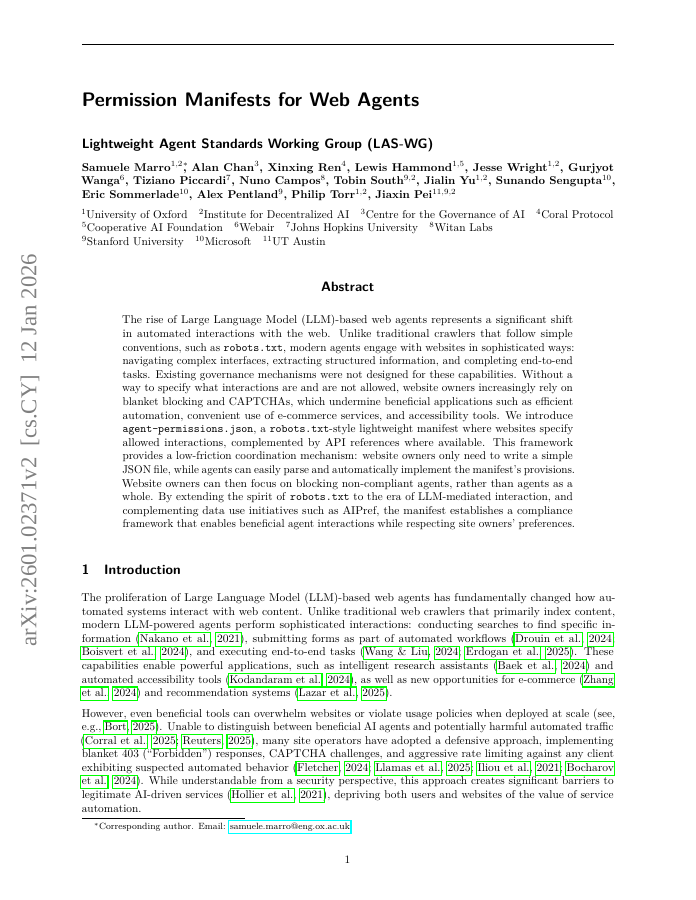
The rise of Large Language Model (LLM)-based web agents represents a significant shift in automated interactions with the web. Unlike traditional crawlers that follow simple conventions, such as robots.txt, modern agents engage with websites in sophisticated ways: navigating complex interfaces, extracting structured information, and completing end-to-end tasks. Existing governance mechanisms were not designed for these capabilities. Without a way to specify what interactions are and are not allowed, website owners increasingly rely on blanket blocking and CAPTCHAs, which undermine beneficial applications such as efficient automation, convenient use of e-commerce services, and accessibility tools. We introduce agent-permissions.json, a robots.txt-style lightweight manifest where websites specify allowed interactions, complemented by API references where available. This framework provides a low-friction coordination mechanism: website owners only need to write a simple JSON file, while agents can easily parse and automatically implement the manifest's provisions. Website owners can then focus on blocking non-compliant agents, rather than agents as a whole. By extending the spirit of robots.txt to the era of LLM-mediated interaction, and complementing data use initiatives such as AIPref, the manifest establishes a compliance framework that enables beneficial agent interactions while respecting site owners' preferences.
Permission Manifests for Web Agents
Large language model-based web agents require new governance frameworks, leading to the introduction of agent-permissions.json as a lightweight manifest for specifying allowed interactions similar to robots.txt.
- Preview
- Year
- 2025
- Venue
- arXiv 2025
- Authors
- 13
- Hosting
- Abstract onlyARXIV-DEFAULT
Cite
Notes
Only stored in your browser.
Attribution
- Abstract & full text
- arxiv.org/abs/2601.02371ARXIV-DEFAULT
- TL;DR
- Semantic Scholar