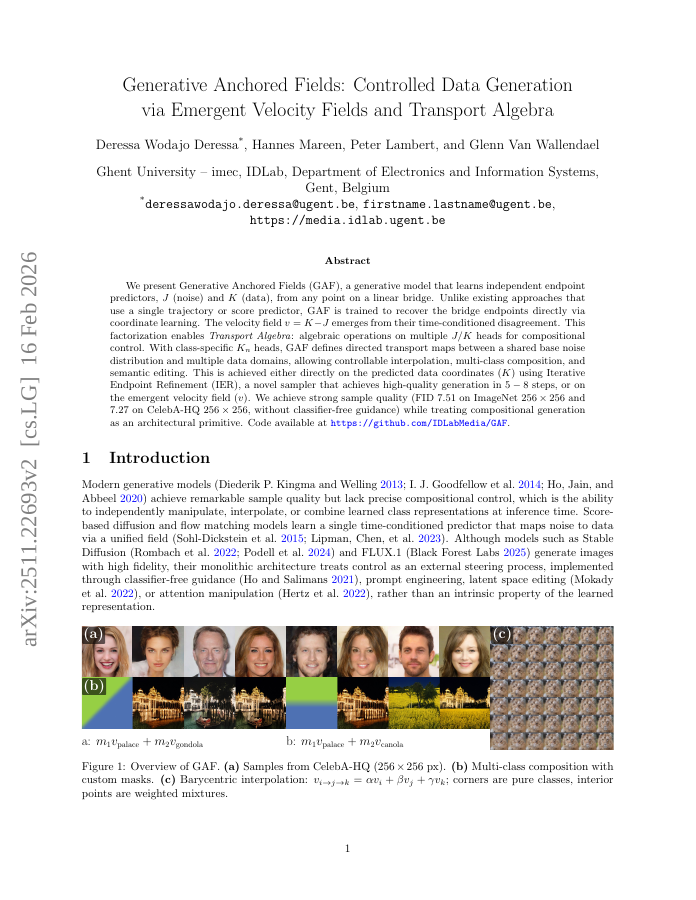
We present Generative Anchored Fields (GAF), a generative model that learns independent endpoint predictors, J (noise) and K (data), from any point on a linear bridge. Unlike existing approaches that use a single trajectory or score predictor, GAF is trained to recover the bridge endpoints directly via coordinate learning. The velocity field v=K-J emerges from their time-conditioned disagreement. This factorization enables Transport Algebra: algebraic operations on multiple J/K heads for compositional control. With class-specific K_n heads, GAF defines directed transport maps between a shared base noise distribution and multiple data domains, allowing controllable interpolation, multi-class composition, and semantic editing. This is achieved either directly on the predicted data coordinates (K) using Iterative Endpoint Refinement (IER), a novel sampler that achieves high-quality generation in 5-8 steps, or on the emergent velocity field (v). We achieve strong sample quality (FID 7.51 on ImageNet 256times256 and 7.27 on CelebA-HQ 256times 256, without classifier-free guidance) while treating compositional generation as an architectural primitive. Code available at https://github.com/IDLabMedia/GAF.
Generative Anchored Fields: Controlled Data Generation via Emergent Velocity Fields and Transport Algebra
Generative Anchored Fields learns independent noise and data predictors from linear bridges to enable compositional control through transport algebra and efficient high-quality generation.
- Preview
- Year
- 2025
- Venue
- arXiv 2025
- Authors
- 4
- Hosting
- Abstract onlyARXIV-DEFAULT
Cite
Notes
Only stored in your browser.
Attribution
- Abstract & full text
- arxiv.org/abs/2511.22693ARXIV-DEFAULT
- TL;DR
- Semantic Scholar