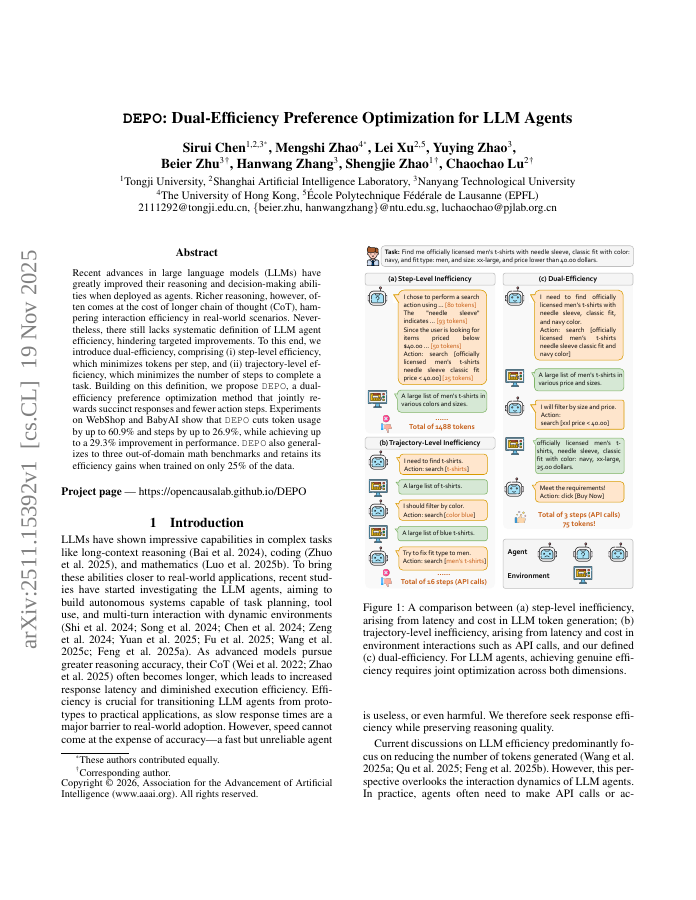
Recent advances in large language models (LLMs) have greatly improved their reasoning and decision-making abilities when deployed as agents. Richer reasoning, however, often comes at the cost of longer chain of thought (CoT), hampering interaction efficiency in real-world scenarios. Nevertheless, there still lacks systematic definition of LLM agent efficiency, hindering targeted improvements. To this end, we introduce dual-efficiency, comprising (i) step-level efficiency, which minimizes tokens per step, and (ii) trajectory-level efficiency, which minimizes the number of steps to complete a task. Building on this definition, we propose DEPO, a dual-efficiency preference optimization method that jointly rewards succinct responses and fewer action steps. Experiments on WebShop and BabyAI show that DEPO cuts token usage by up to 60.9% and steps by up to 26.9%, while achieving up to a 29.3% improvement in performance. DEPO also generalizes to three out-of-domain math benchmarks and retains its efficiency gains when trained on only 25% of the data. Our project page is at https://opencausalab.github.io/DEPO.
DEPO: Dual-Efficiency Preference Optimization for LLM Agents
DEPO optimizes large language model agents for efficiency by minimizing both step count and tokens while maintaining or improving performance.
- Preview
- Year
- 2025
- Venue
- arXiv 2025
- Authors
- 8
- Hosting
- Abstract onlyARXIV-DEFAULT
Cite
Notes
Only stored in your browser.
Attribution
- Abstract & full text
- arxiv.org/abs/2511.15392ARXIV-DEFAULT
- TL;DR
- Semantic Scholar