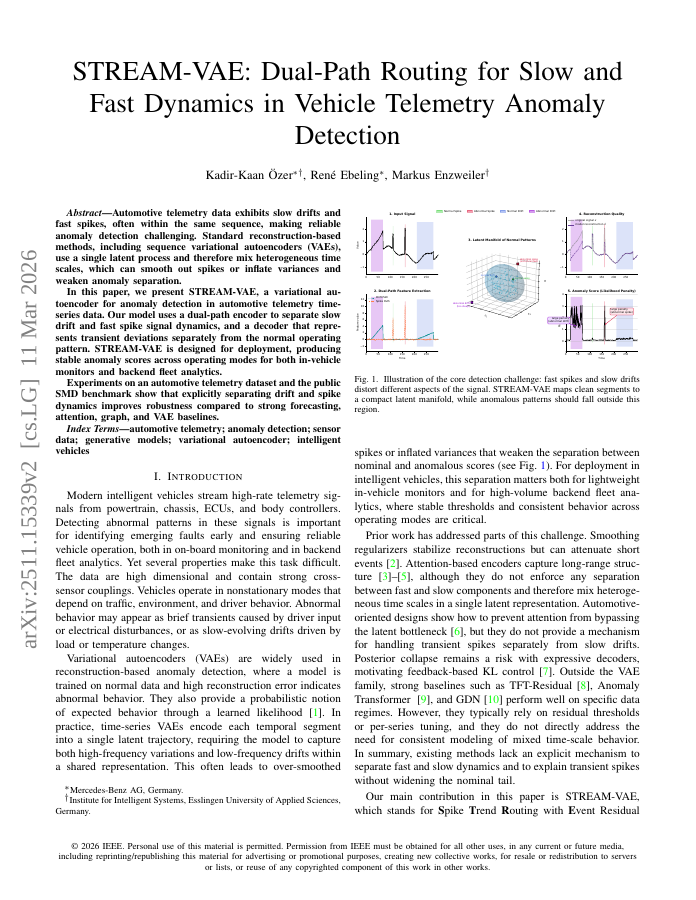
Automotive telemetry data exhibits slow drifts and fast spikes, often within the same sequence, making reliable anomaly detection challenging. Standard reconstruction-based methods, including sequence variational autoencoders (VAEs), use a single latent process and therefore mix heterogeneous time scales, which can smooth out spikes or inflate variances and weaken anomaly separation. In this paper, we present STREAM-VAE, a variational autoencoder for anomaly detection in automotive telemetry time-series data. Our model uses a dual-path encoder to separate slow drift and fast spike signal dynamics, and a decoder that represents transient deviations separately from the normal operating pattern. STREAM-VAE is designed for deployment, producing stable anomaly scores across operating modes for both in-vehicle monitors and backend fleet analytics. Experiments on an automotive telemetry dataset and the public SMD benchmark show that explicitly separating drift and spike dynamics improves robustness compared to strong forecasting, attention, graph, and VAE baselines.
STREAM-VAE: Dual-Path Routing for Slow and Fast Dynamics in Vehicle Telemetry Anomaly Detection
STREAM-VAE uses a dual-path encoder to separate slow drift and fast spike dynamics in automotive telemetry data, improving anomaly detection robustness over standard VAE approaches.
- Preview
- Year
- 2025
- Venue
- arXiv 2025
- Authors
- 3
- Hosting
- Abstract onlyARXIV-DEFAULT
Cite
Notes
Only stored in your browser.
Attribution
- Abstract & full text
- arxiv.org/abs/2511.15339ARXIV-DEFAULT
- TL;DR
- Semantic Scholar