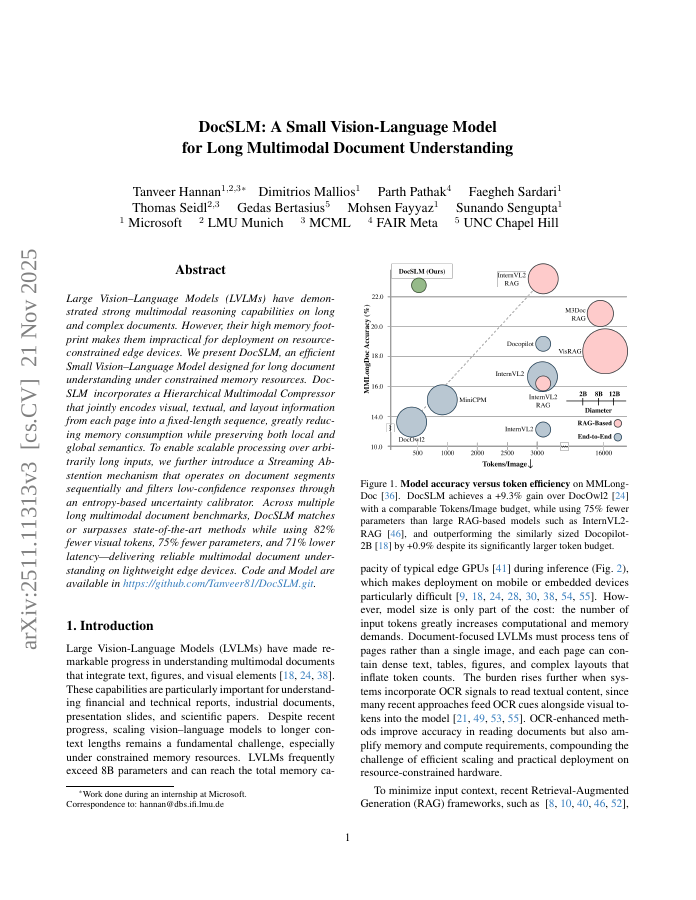
Large Vision-Language Models (LVLMs) have demonstrated strong multimodal reasoning capabilities on long and complex documents. However, their high memory footprint makes them impractical for deployment on resource-constrained edge devices. We present DocSLM, an efficient Small Vision-Language Model designed for long-document understanding under constrained memory resources. DocSLM incorporates a Hierarchical Multimodal Compressor that jointly encodes visual, textual, and layout information from each page into a fixed-length sequence, greatly reducing memory consumption while preserving both local and global semantics. To enable scalable processing over arbitrarily long inputs, we introduce a Streaming Abstention mechanism that operates on document segments sequentially and filters low-confidence responses using an entropy-based uncertainty calibrator. Across multiple long multimodal document benchmarks, DocSLM matches or surpasses state-of-the-art methods while using 82% fewer visual tokens, 75% fewer parameters, and 71% lower latency, delivering reliable multimodal document understanding on lightweight edge devices. Code and Model are available in https://github.com/Tanveer81/DocSLM.git.
DocSLM: A Small Vision-Language Model for Long Multimodal Document Understanding
DocSLM is an efficient vision-language model for long-document understanding that uses a hierarchical compressor and streaming abstention mechanism to reduce memory usage while maintaining performance on edge devices.
- Preview
- Year
- 2025
- Venue
- arXiv 2025
- Authors
- 8
- Hosting
- Abstract onlyARXIV-DEFAULT
Cite
Notes
Only stored in your browser.
Attribution
- Abstract & full text
- arxiv.org/abs/2511.11313ARXIV-DEFAULT
- TL;DR
- Semantic Scholar