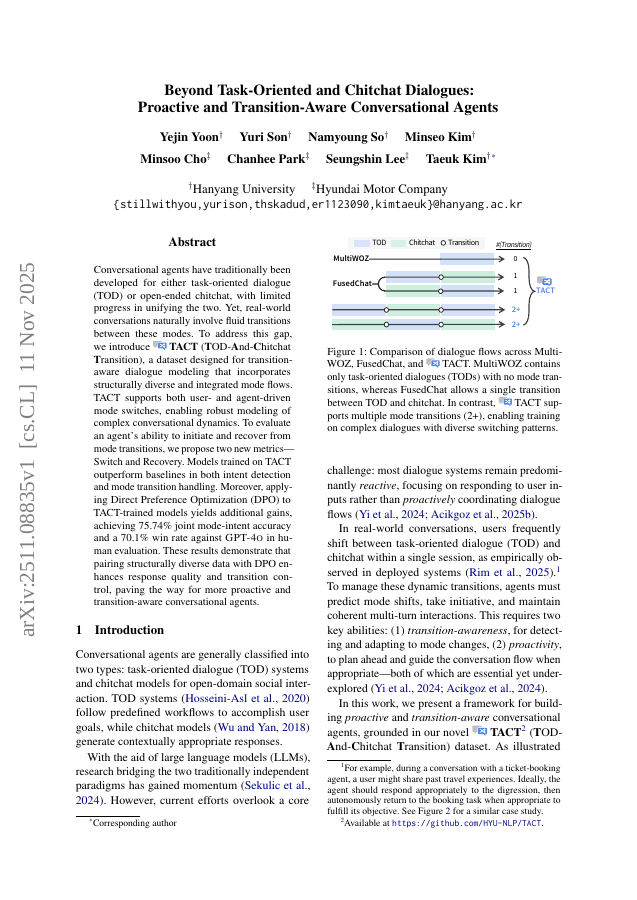
Conversational agents have traditionally been developed for either task-oriented dialogue (TOD) or open-ended chitchat, with limited progress in unifying the two. Yet, real-world conversations naturally involve fluid transitions between these modes. To address this gap, we introduce TACT (TOD-And-Chitchat Transition), a dataset designed for transition-aware dialogue modeling that incorporates structurally diverse and integrated mode flows. TACT supports both user- and agent-driven mode switches, enabling robust modeling of complex conversational dynamics. To evaluate an agent's ability to initiate and recover from mode transitions, we propose two new metrics -- Switch and Recovery. Models trained on TACT outperform baselines in both intent detection and mode transition handling. Moreover, applying Direct Preference Optimization (DPO) to TACT-trained models yields additional gains, achieving 75.74% joint mode-intent accuracy and a 70.1% win rate against GPT-4o in human evaluation. These results demonstrate that pairing structurally diverse data with DPO enhances response quality and transition control, paving the way for more proactive and transition-aware conversational agents.
Beyond Task-Oriented and Chitchat Dialogues: Proactive and Transition-Aware Conversational Agents
TACT dataset and Direct Preference Optimization improve conversational agents' ability to handle transitions between task-oriented dialogue and chitchat, leading to enhanced response quality and control.
- Preview
- Year
- 2025
- Venue
- arXiv 2025
- Authors
- 8
- Hosting
- Abstract onlyARXIV-DEFAULT
Cite
Notes
Only stored in your browser.
Attribution
- Abstract & full text
- arxiv.org/abs/2511.08835ARXIV-DEFAULT
- TL;DR
- Semantic Scholar