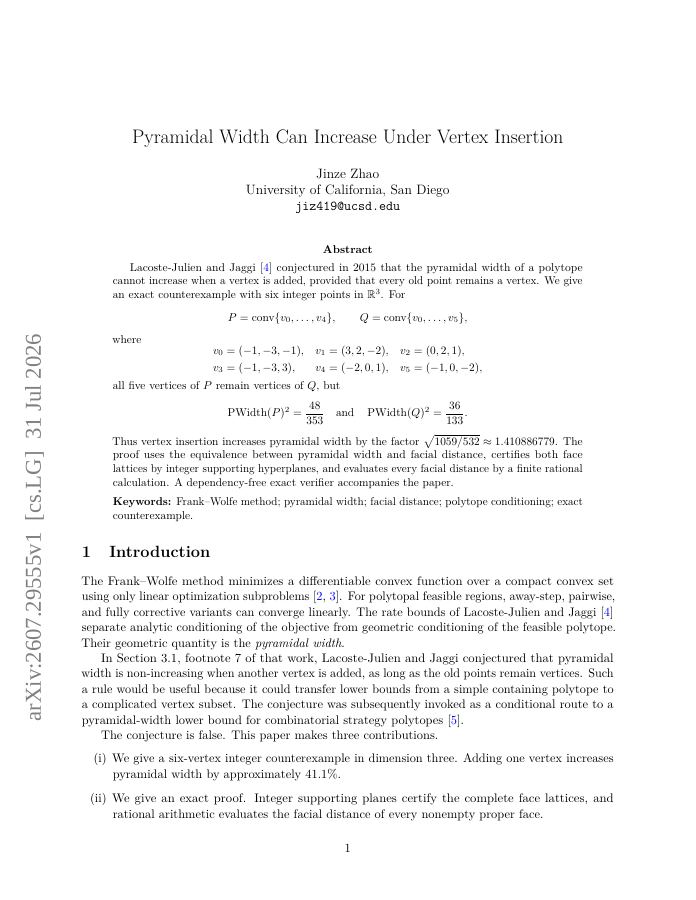
Lacoste-Julien and Jaggi conjectured in 2015 that the pyramidal width of a polytope cannot increase when a vertex is added, provided that every old point remains a vertex. We give an exact counterexample with six integer points in \R^3. For [ P=\conv{v_0,\ldots,v_4},\qquad Q=\conv{v_0,\ldots,v_5}, ] where [ \begin{aligned} v_0&=(-1,-3,-1), & v_1&=(3,2,-2), & v_2&=(0,2,1),\ v_3&=(-1,-3,3), & v_4&=(-2,0,1), & v_5&=(-1,0,-2), \end{aligned} ] all five vertices of P remain vertices of Q, but [ \PWidth(P)^2=\frac{48}{353} \quadand\quad \PWidth(Q)^2=\frac{36}{133}. ] Thus vertex insertion increases pyramidal width by the factor \sqrt{1059/532}\approx 1.410886779. The proof uses the equivalence between pyramidal width and facial distance, certifies both face lattices by integer supporting hyperplanes, and evaluates every facial distance by a finite rational calculation. A dependency-free exact verifier accompanies the paper.
Pyramidal Width Can Increase Under Vertex Insertion
Lacoste-Julien and Jaggi conjectured in 2015 that the pyramidal width of a polytope cannot increase when a vertex is added, provided that every old point remains a vertex. We give an exact counterexample with six integer points in $\R^3$.
- Preview
- Year
- 2026
- Hosting
- Abstract onlyARXIV-DEFAULT
Cite
Notes
Only stored in your browser.
Attribution
- Abstract & full text
- arxiv.org/abs/2607.29555ARXIV-DEFAULT
- TL;DR
- Semantic Scholar