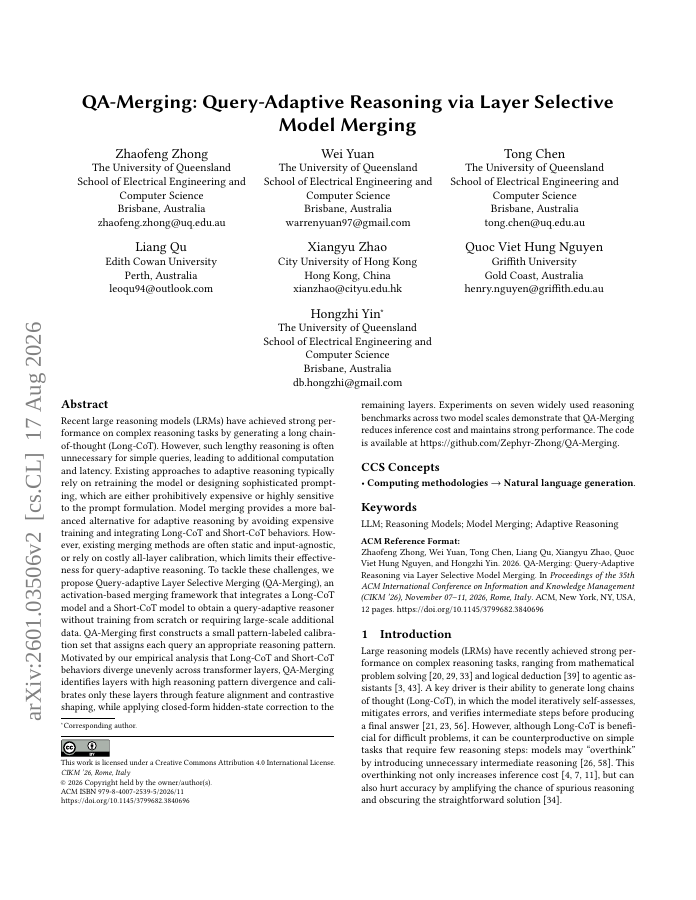
Recent large reasoning models (LRMs) have achieved strong performance on complex reasoning tasks by generating a long chain-of-thought (Long-CoT). However, such lengthy reasoning is often unnecessary for simple queries, leading to additional computation and latency. Existing approaches to adaptive reasoning typically rely on retraining the model or designing sophisticated prompting, which are either prohibitively expensive or highly sensitive to the prompt formulation. Model merging provides a more balanced alternative for adaptive reasoning by avoiding expensive training and integrating Long-CoT and Short-CoT behaviors. However, existing merging methods are often static and input-agnostic, or rely on costly all-layer calibration, which limits their effectiveness for query-adaptive reasoning. To tackle these challenges, we propose Query-adaptive Layer Selective Merging (QA-Merging), an activation-based merging framework that integrates a Long-CoT model and a Short-CoT model to obtain a query-adaptive reasoner without training from scratch or requiring large-scale additional data. QA-Merging first constructs a small pattern-labeled calibration set that assigns each query an appropriate reasoning pattern. Motivated by our empirical analysis that Long-CoT and Short-CoT behaviors diverge unevenly across transformer layers, QA-Merging identifies layers with high reasoning pattern divergence and calibrates only these layers through feature alignment and contrastive shaping, while applying closed-form hidden-state correction to the remaining layers. Experiments on seven widely used reasoning benchmarks across two model scales demonstrate that QA-Merging reduces inference cost and maintains strong performance.
QA-Merging: Query-Adaptive Reasoning via Layer Selective Model Merging
Recent large reasoning models (LRMs) have achieved strong performance on complex reasoning tasks by generating a long chain-of-thought (Long-CoT). However, such lengthy reasoning is often unnecessary for simple queries, leading to additional computation and latency.
- Preview
- Year
- 2026
- Hosting
- Full text hostedCC-BY-4.0
Cite
Notes
Only stored in your browser.
Attribution
- Abstract & full text
- arxiv.org/abs/2601.03506CC-BY-4.0
- TL;DR
- Semantic Scholar