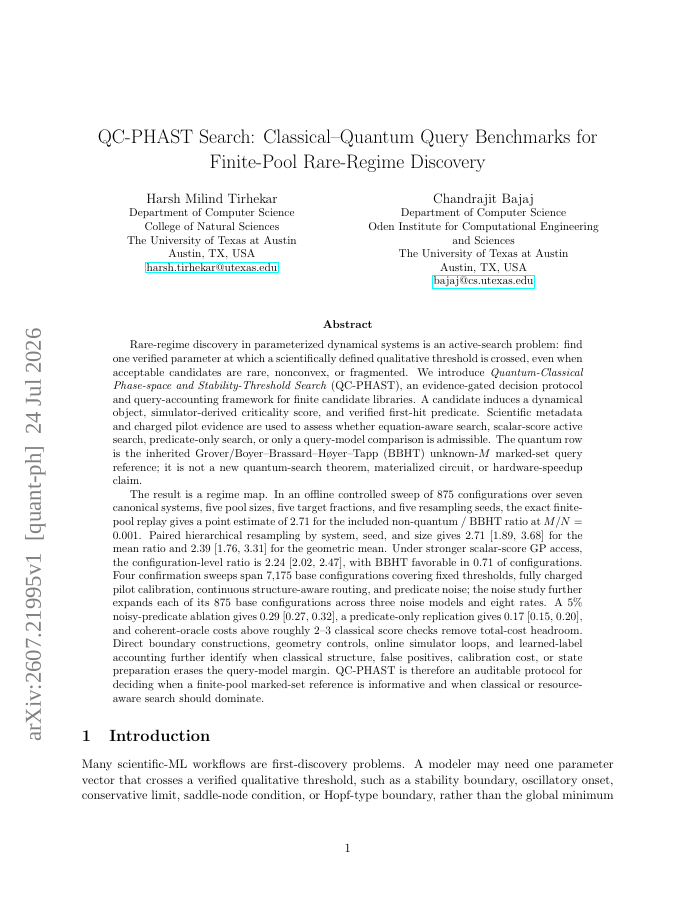
Rare-regime discovery in parameterized dynamical systems is an active-search problem: find one verified parameter at which a scientifically defined qualitative threshold is crossed, even when acceptable candidates are rare, nonconvex, or fragmented. We introduce Quantum-Classical Phase-space and Stability-Threshold Search (QC-PHAST), an evidence-gated decision protocol and query-accounting framework for finite candidate libraries. A candidate induces a dynamical object, simulator-derived criticality score, and verified first-hit predicate. Scientific metadata and charged pilot evidence are used to assess whether equation-aware search, scalar-score active search, predicate-only search, or only a query-model comparison is admissible. The quantum row is the inherited Grover/Boyer--Brassard--Hoyer--Tapp (BBHT) unknown-M marked-set query reference; it is not a new quantum-search theorem, materialized circuit, or hardware-speedup claim. The result is a regime map. Direct boundary constructions, geometry controls, online simulator loops, and learned-label accounting further identify when classical structure, false positives, calibration cost, or state preparation erases the query-model margin. QC-PHAST is therefore an auditable protocol for deciding when a finite-pool marked-set reference is informative and when classical or resource-aware search should dominate.
QC-PHAST Search: Classical--Quantum Query Benchmarks for Finite-Pool Rare-Regime Discovery
Rare-regime discovery in parameterized dynamical systems is an active-search problem: find one verified parameter at which a scientifically defined qualitative threshold is crossed, even when acceptable candidates are rare, nonconvex, or fragmented.
- Preview
- Year
- 2026
- Hosting
- Excerpt onlyCC-BY-NC-SA-4.0
Cite
Notes
Only stored in your browser.
Attribution
- Abstract & full text
- arxiv.org/abs/2607.21995CC-BY-NC-SA-4.0
- TL;DR
- Semantic Scholar