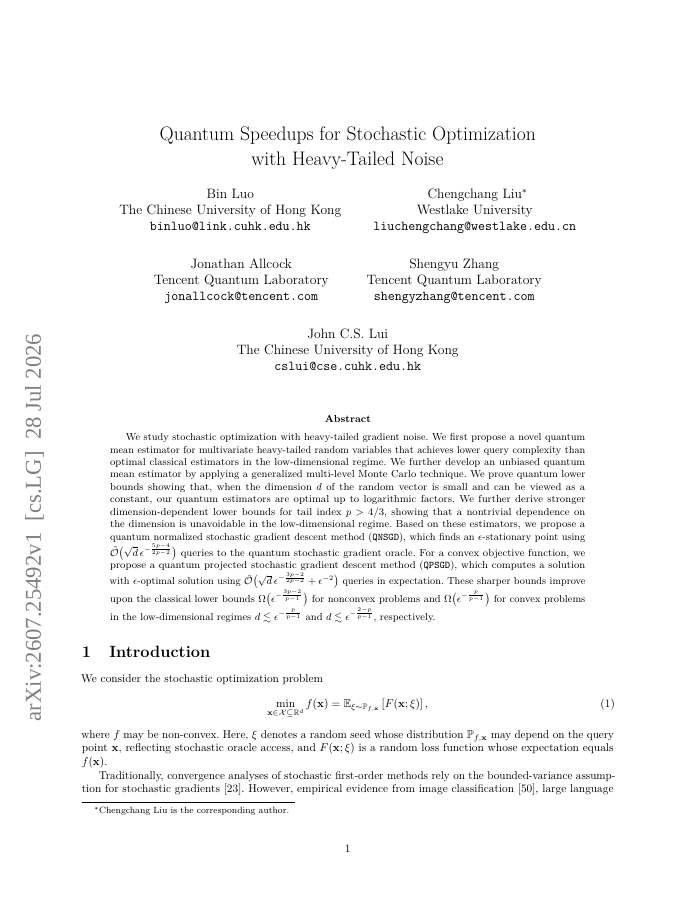
We study stochastic optimization with heavy-tailed gradient noise. We first propose a novel quantum mean estimator for multivariate heavy-tailed random variables that achieves lower query complexity than optimal classical estimators in the low-dimensional regime. We further develop an unbiased quantum mean estimator by applying a generalized multi-level Monte Carlo technique. We prove quantum lower bounds showing that, when the dimension d of the random vector is small and can be viewed as a constant, our quantum estimators are optimal up to logarithmic factors. We further derive stronger dimension-dependent lower bounds for tail index p>4/3, showing that a nontrivial dependence on the dimension is unavoidable in the low-dimensional regime. Based on these estimators, we propose a quantum normalized stochastic gradient descent method (QNSGD), which finds an ε-stationary point using \tilde{O}\big(\sqrt d,ε^{-\frac{5p-4}{2p-2}}\big) queries to the quantum stochastic gradient oracle. For a convex objective function, we propose a quantum projected stochastic gradient descent method (QPSGD), which computes a solution with ε-optimal solution using \tilde{O}\big(\sqrt d,ε^{-\frac{3p-2}{2p-2}}+ε^{-2}\big) queries in expectation. These sharper bounds improve upon the classical lower bounds Ω\big(ε^{-\frac{3p-2}{p-1}}\big) for nonconvex problems and Ω\big(ε^{-\frac{p}{p-1}}\big) for convex problems in the low-dimensional regimes d\lesssimε^{-\frac{p}{p-1}} and d\lesssimε^{-\frac{2-p}{p-1}}, respectively.
Quantum Speedups for Stochastic Optimization with Heavy-Tailed Noise
We study stochastic optimization with heavy-tailed gradient noise. We first propose a novel quantum mean estimator for multivariate heavy-tailed random variables that achieves lower query complexity than optimal classical estimators in the low-dimensional regime.
- Preview
- Year
- 2026
- Hosting
- Full text hostedCC-BY-4.0
Cite
Notes
Only stored in your browser.
Attribution
- Abstract & full text
- arxiv.org/abs/2607.25492CC-BY-4.0
- TL;DR
- Semantic Scholar