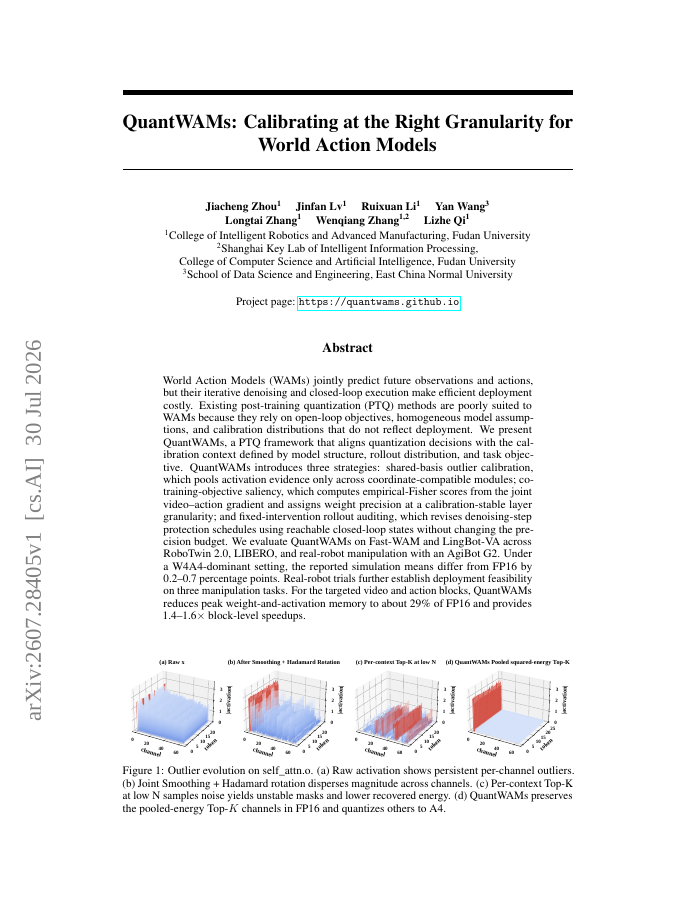
World Action Models (WAMs) jointly predict future observations and actions, but their iterative denoising and closed-loop execution make efficient deployment costly. Existing post-training quantization (PTQ) methods are poorly suited to WAMs because they rely on open-loop objectives, homogeneous model assumptions, and calibration distributions that do not reflect deployment. We present QuantWAMs, a PTQ framework that aligns quantization decisions with the calibration context defined by model structure, rollout distribution, and task objective. QuantWAMs introduces three strategies: shared-basis outlier calibration, which pools activation evidence only across coordinate-compatible modules; co-training-objective saliency, which computes empirical-Fisher scores from the joint video--action gradient and assigns weight precision at a calibration-stable layer granularity; and fixed-intervention rollout auditing, which revises denoising-step protection schedules using reachable closed-loop states without changing the precision budget. We evaluate QuantWAMs on Fast-WAM and LingBot-VA across RoboTwin 2.0, LIBERO, and real-robot manipulation with an AgiBot G2. Under a W4A4-dominant setting, the reported simulation means differ from FP16 by 0.2--0.7 percentage points. Real-robot trials further establish deployment feasibility on three manipulation tasks. For the targeted video and action blocks, QuantWAMs reduces peak weight-and-activation memory to about 29% of FP16 and provides 1.4--1.6\times block-level speedups.
QuantWAMs: Calibrating at the Right Granularity for World Action Models
World Action Models (WAMs) jointly predict future observations and actions, but their iterative denoising and closed-loop execution make efficient deployment costly. Existing post-training quantization (PTQ) methods are poorly suited to WAMs because they rely on open-loop…
- Preview
- Year
- 2026
- Hosting
- Full text hostedCC-BY-4.0
Cite
Notes
Only stored in your browser.
Attribution
- Abstract & full text
- arxiv.org/abs/2607.28405CC-BY-4.0
- TL;DR
- Semantic Scholar