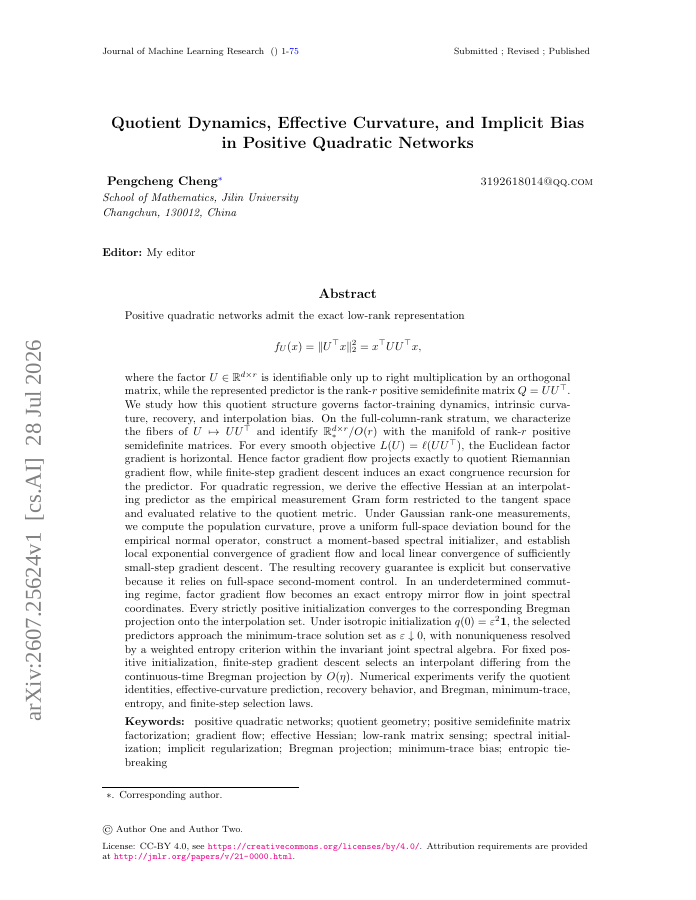
Positive quadratic networks admit the low-rank representation f_U(x)=x^top UU^top x, where Uinmathbb{R}^{dtimes r} is identifiable only up to right orthogonal multiplication, representing a rank-r PSD matrix Q=UU^top. We study how this quotient structure governs training dynamics, curvature, recovery, and interpolation bias. On the full-column-rank stratum, we identify mathbb{R}^{dtimes r}_*/O(r) with the rank-r PSD manifold. For smooth objectives L(U)=ell(UU^top), the Euclidean factor gradient is horizontal. Thus, factor gradient flow projects exactly to quotient Riemannian gradient flow, while finite-step gradient descent induces an exact congruence recursion for the predictor. For quadratic regression, we derive the effective Hessian at interpolators as the empirical measurement Gram form restricted to the tangent space relative to the quotient metric. Under Gaussian rank-one measurements, we compute population curvature, prove uniform deviation bounds for the empirical normal operator, construct a spectral initializer, and establish local exponential convergence for gradient flow and linear convergence for small-step descent. Recovery guarantees are explicit but conservative due to reliance on full-space second-moment control. In underdetermined commuting regimes, factor gradient flow becomes an exact entropy mirror flow in joint spectral coordinates. Strictly positive initializations converge to Bregman projections onto the interpolation set. With isotropic initialization q(0)=varepsilon^2mathbf{1}, predictors approach the minimum-trace solution set as varepsilondownarrow0, resolving nonuniqueness via weighted entropy within the invariant joint spectral algebra. Finite-step descent selects interpolants differing from continuous-time Bregman projections by O(eta). Numerical experiments verify these quotient identities, curvature predictions, recovery behaviors, and selection laws.
Quotient Dynamics, Effective Curvature, and Implicit Bias in Positive Quadratic Networks
Positive quadratic networks admit the low-rank representation f_U(x)=x^top UU^top x, where Uinmathbb{R}^{dtimes r} is identifiable only up to right orthogonal multiplication, representing a rank-r PSD matrix Q=UU^top.
- Preview
- Year
- 2026
- Hosting
- Full text hostedCC-BY-4.0
Cite
Notes
Only stored in your browser.
Attribution
- Abstract & full text
- arxiv.org/abs/2607.25624CC-BY-4.0
- TL;DR
- Semantic Scholar