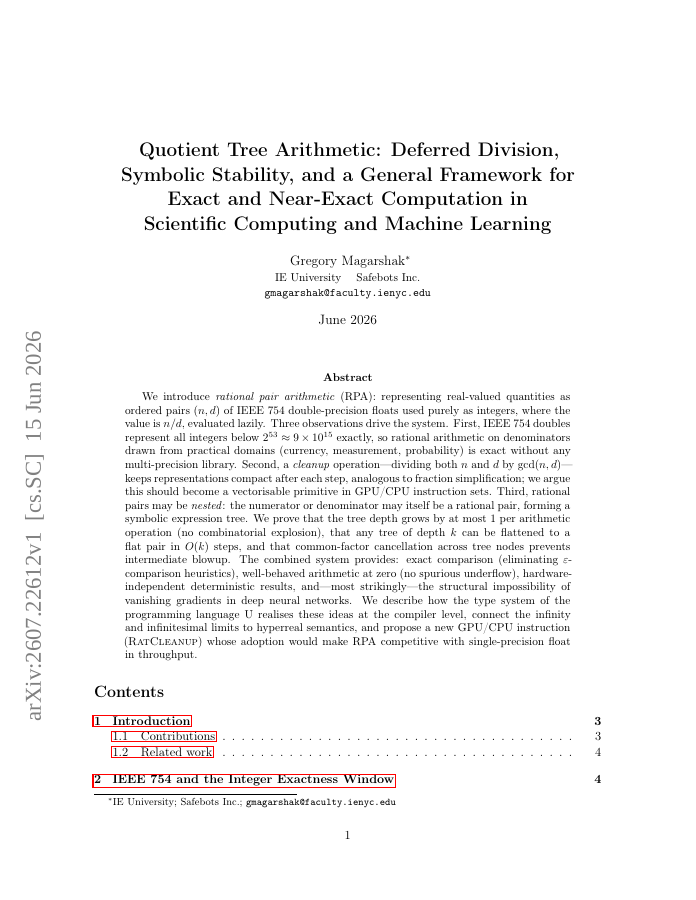
We introduce Quotient Tree Arithmetic (QTA), a computational substrate in which values are represented as deferred quotient pairs (N, D) whose ratio is evaluated lazily at a designated materialization boundary. The framework applies to any domain: IEEE 754 doubles used as exact integer containers give exact rational arithmetic within the 2^53 exactness window; arbitrary IEEE doubles extend coverage to transcendental values including machine learning activations such as exp(x) and sqrt(x). Three structural theorems underpin QTA. (1) Bounded Depth Growth: each arithmetic operation increases tree depth by at most 1, giving O(m) tree size after m operations with no combinatorial explosion. (2) Cross-Subtree Cancellation: subtrees appearing in both numerator and denominator positions cancel via reference identity without arithmetic, including transcendental values computed once and shared. (3) Deferred Stability: a single IEEE division at the materialization boundary introduces at most one-half ULP of rounding error, versus O(m) ULP for eager evaluation. For machine learning training, QTA provides: structural prevention of gradient underflow to zero; O(1)-cost gradient computation via chain-rule tape collapse when intermediate activations are reference-identical; shared-weight batch compression reducing DAG storage from O(BLd) to O(L+Bd) for a batch of B examples through L layers; and tracked factor cancellation replacing O(log n) GCD with O(1) trial division when denominators are known. We propose a vectorized hardware normalization instruction (RatCleanup) for SIMD-parallel rational pair reduction. The algebraic foundation is the localization of a ring at its multiplicative set, connecting QTA to algebraic structure theory while grounding it in hardware-native IEEE arithmetic.
Quotient Tree Arithmetic: Deferred-Division Computation with Bounded Symbolic Depth and Cross-Subtree Cancellation
We introduce Quotient Tree Arithmetic (QTA), a computational substrate in which values are represented as deferred quotient pairs (N, D) whose ratio is evaluated lazily at a designated materialization boundary.
- Preview
- Year
- 2026
- Hosting
- Full text hostedCC-BY-4.0
Cite
Notes
Only stored in your browser.
Attribution
- Abstract & full text
- arxiv.org/abs/2607.22612CC-BY-4.0
- TL;DR
- Semantic Scholar